An Extended Full GKS Formulation for High-Efficiency and Low-Memory Two-Phase Flow Simulation

Yiheng Wu · Kai Bai · Xiaopei Liu

ShanghaiTech University

SIGGRAPH 2026ACM Transactions on Graphics

Abstract

Two-phase flows are ubiquitous in nature, exhibiting complex fluid-fluid interactions that challenges numerical simulators. To accurately and efficiently solve two-phase flows, grid-based methods have been widely adopted. Navier-Stokes (NS) solvers consume a small memory footprint, but simultaneously achieving both high performance and low numerical dissipation remains a significant challenge. In contrast, lattice Boltzmann solvers are efficient and have low numerical dissipation, yet they remain memory-intensive, even with state-of-the-art moment-encoding schemes. To date, the simultaneous attainment of high accuracy, exceptional efficiency, and a low memory footprint remains a major challenge in the field. In this paper, we propose a novel two-phase flow solver that achieves this objective. Our work is motivated by extending gas-kinetic scheme (GKS), which is adapted to handle nearly incompressible flows. To allow stable and accurate two-phase flow simulations, we systematically derive a coupled formulation of the GKS method and the phase-field model, incorporating novel mathematical constructs. Combined with robust boundary treatments and specialized techniques for handling turbulent flows, this results a unified framework capable of efficiently simulating two-phase flows, even those with large density contrasts and high Reynolds numbers. Since our formulation is explicit, it achieves exceptional performance when optimized on GPU, making it the fastest kinetic two-phase flow solver to date. Additionally, as it is derived from GKS, it obviates the need to store distribution functions. Thus, it has a small memory footprint, competitive with, or even lower than, that of many NS solvers. As a result, our solver can efficiently simulate complex two-phase flow dynamics at high resolutions using a single commodity GPU. We validate the accuracy of our solver via several benchmark tests, compare its performance with recent methods in various aspects, and demonstrate its capability to replicate a broad range of two-phase flow phenomena, encompassing both typical and large-scale scenarios.

Gallery

Selected results
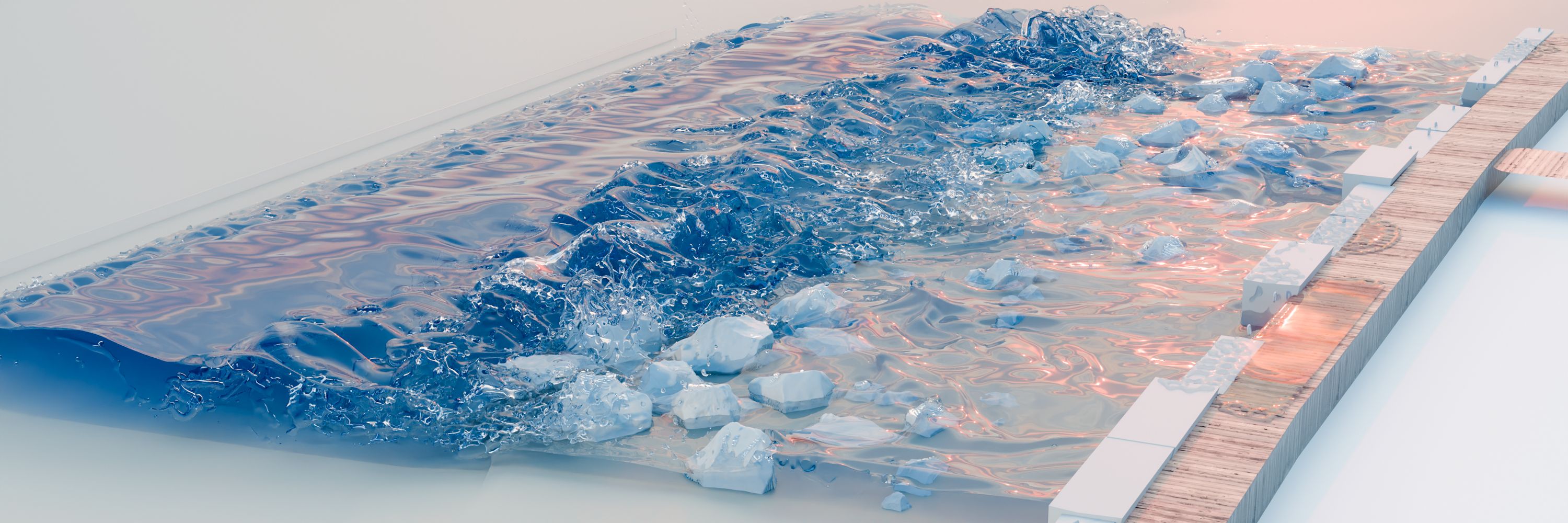
Ocean waves crashing onto the rocky shore, panel 1 of 1

Coastal wave dynamics

Ocean waves crashing onto the rocky shore

Ocean waves advance toward a rocky shore and break against the rocks, producing splashes and turbulent water motion. The flow spreads around the shoreline geometry as successive waves arrive, creating interacting currents and continually reshaping the water surface.

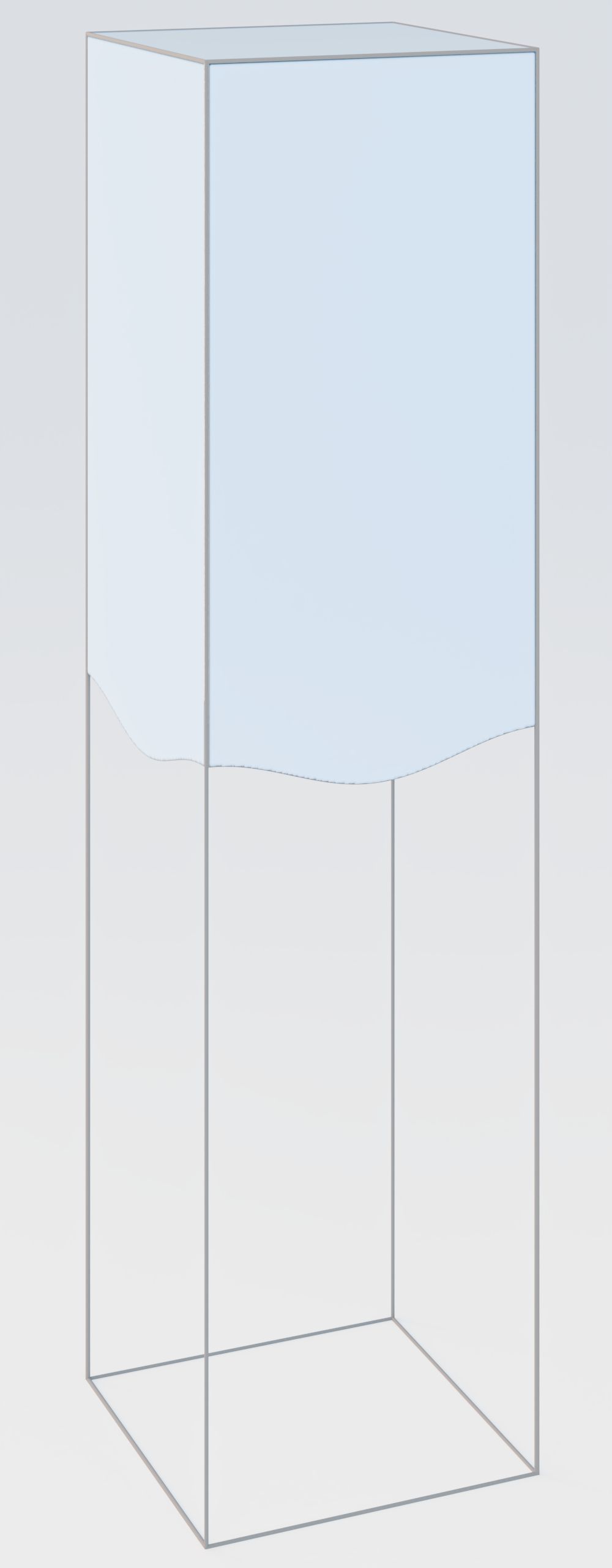
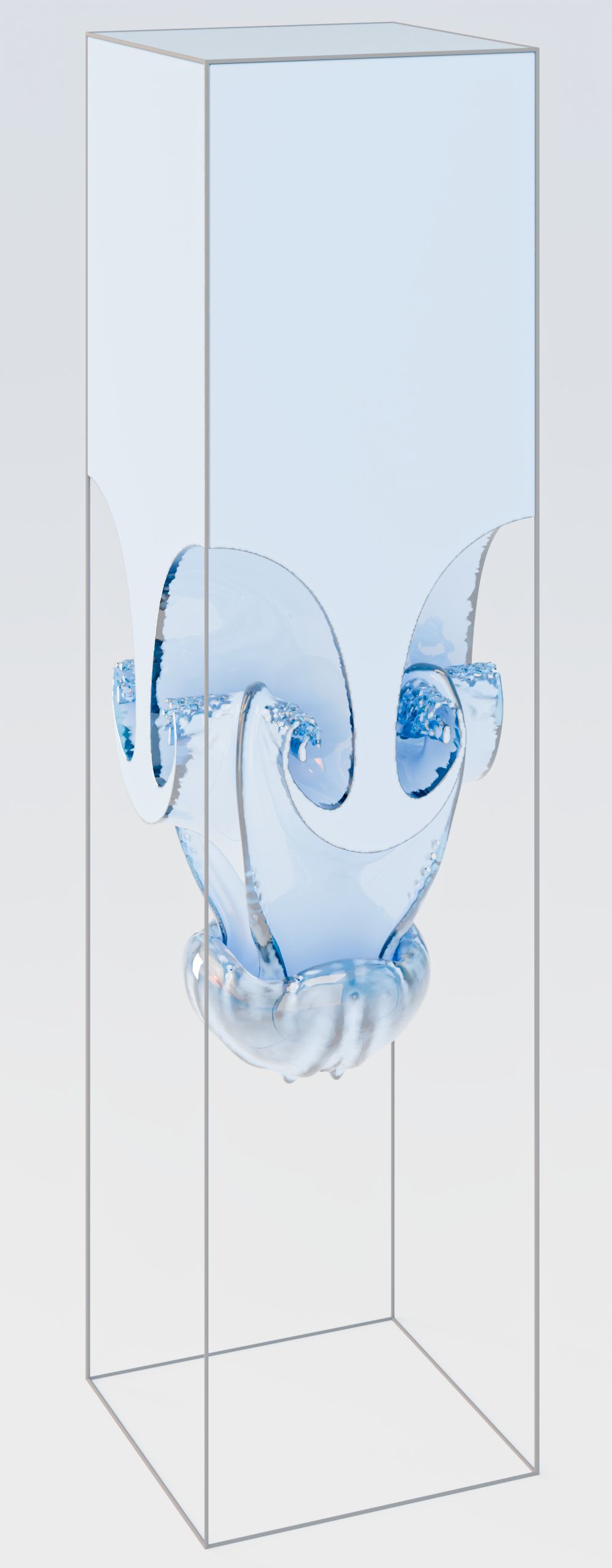
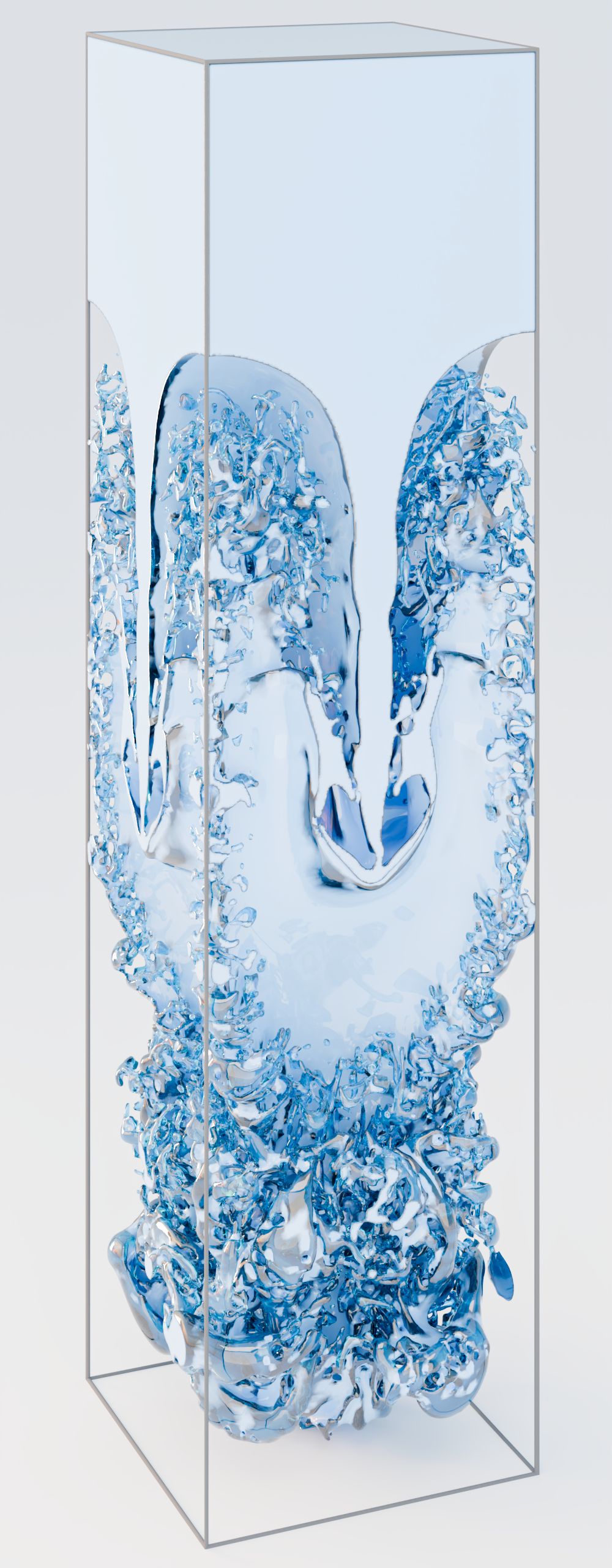
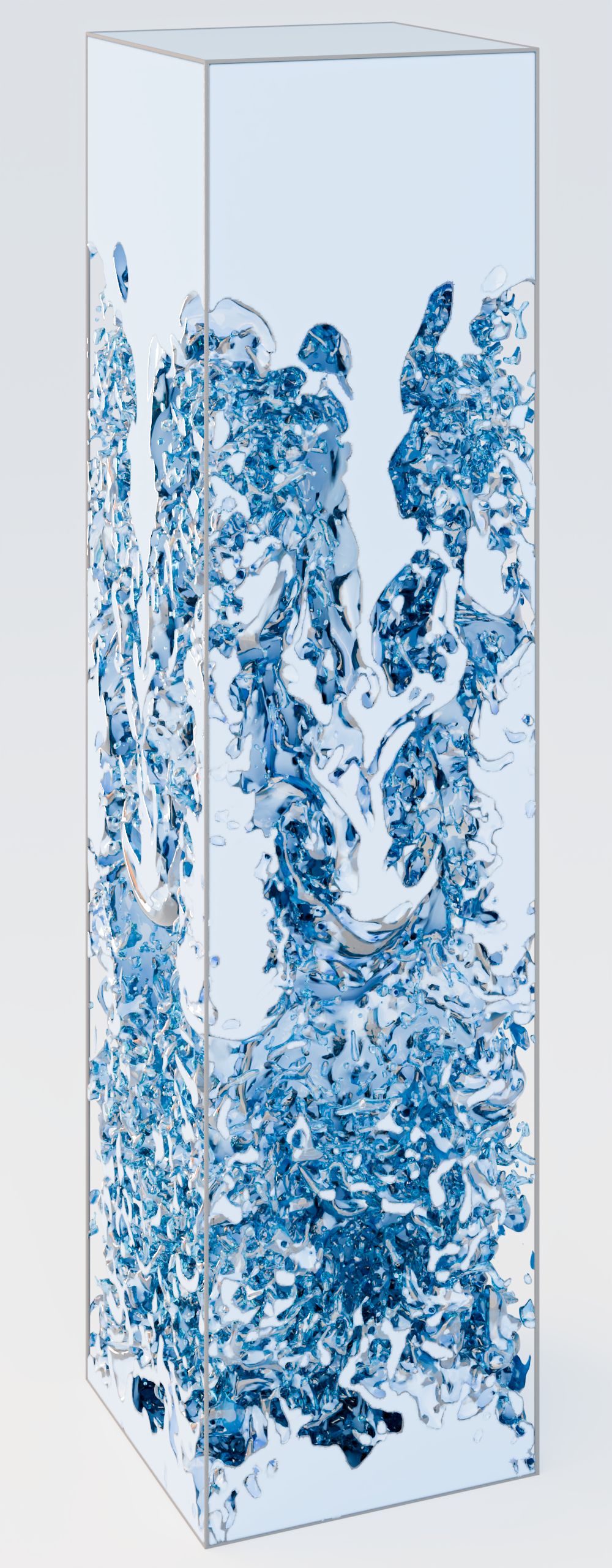
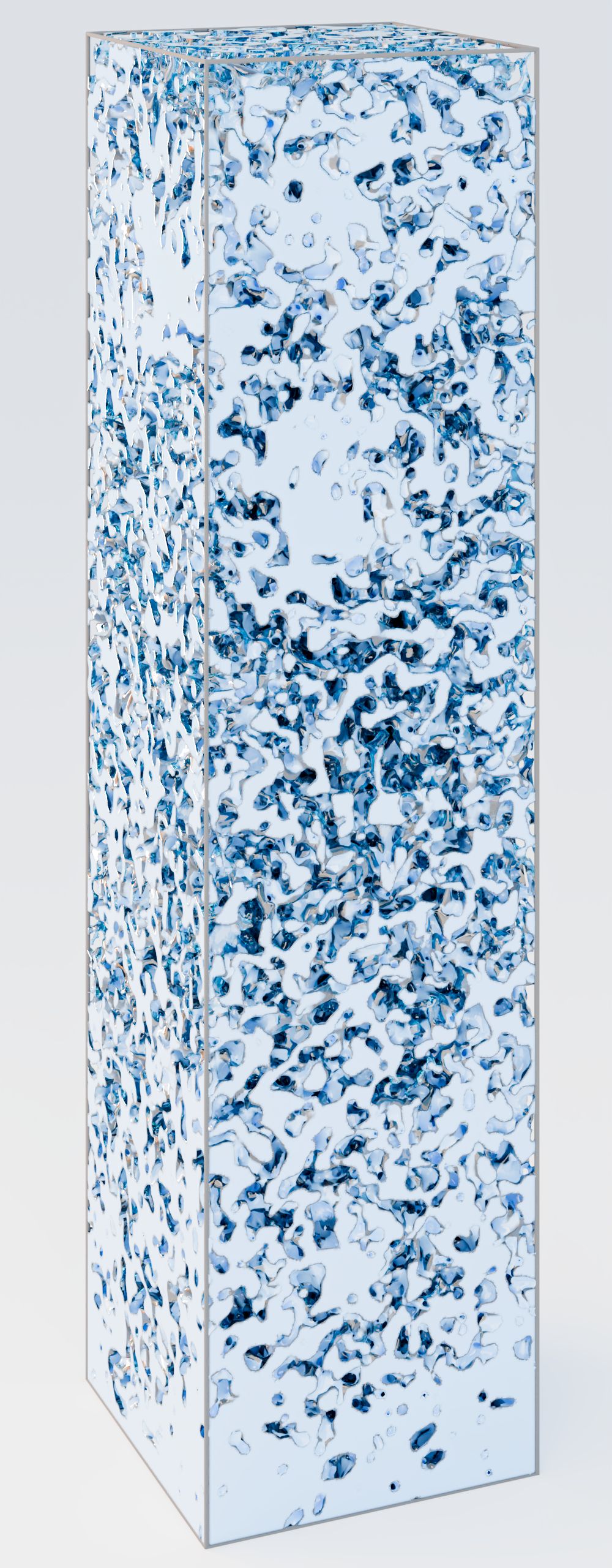
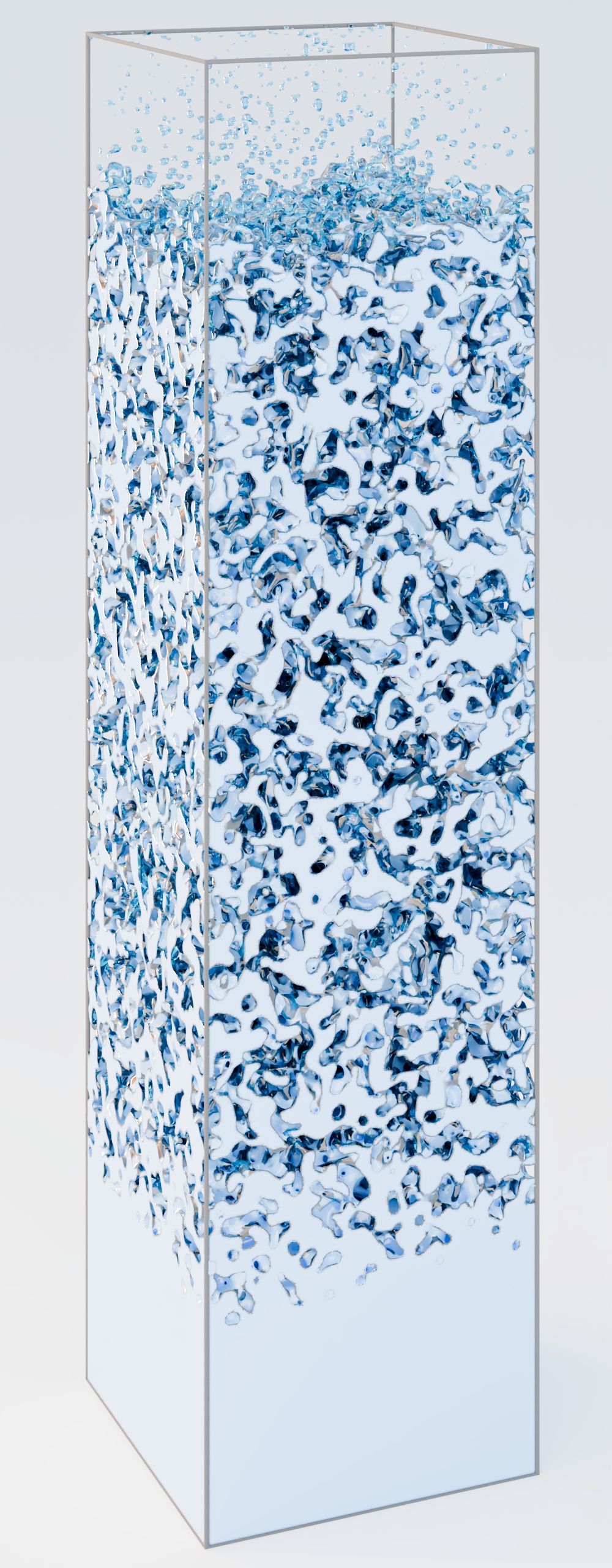
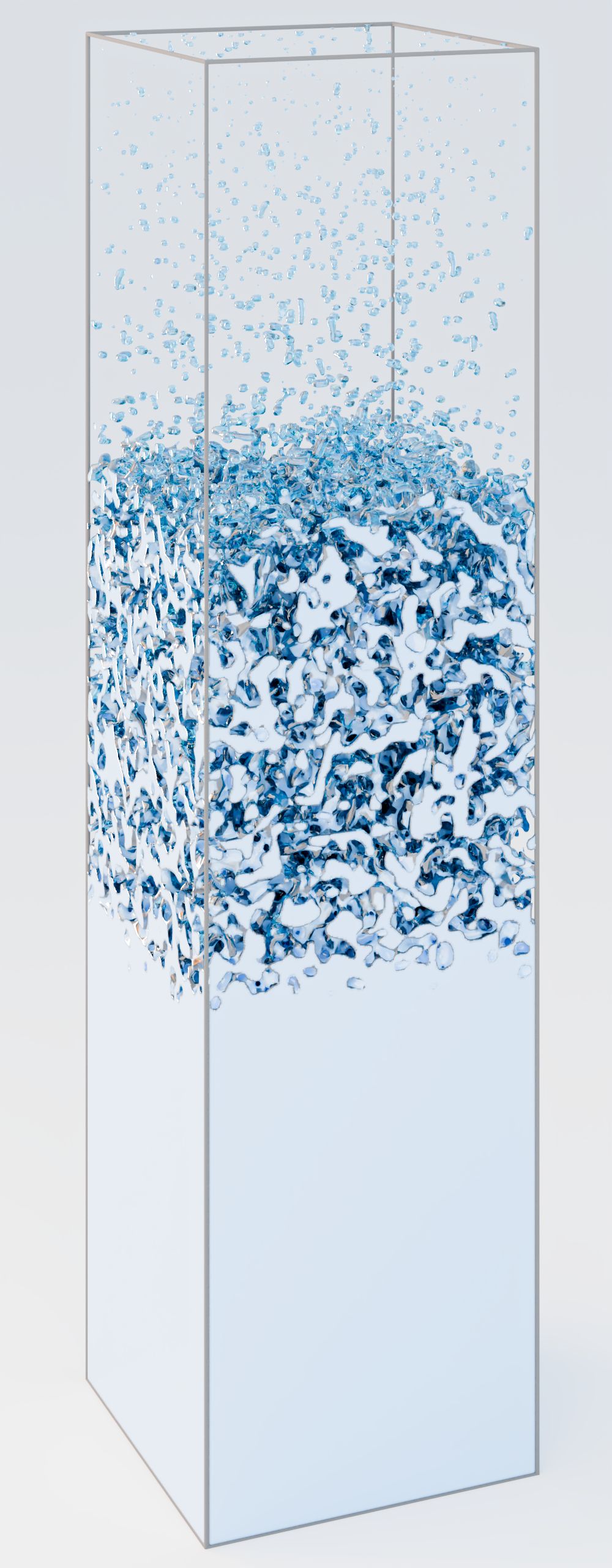
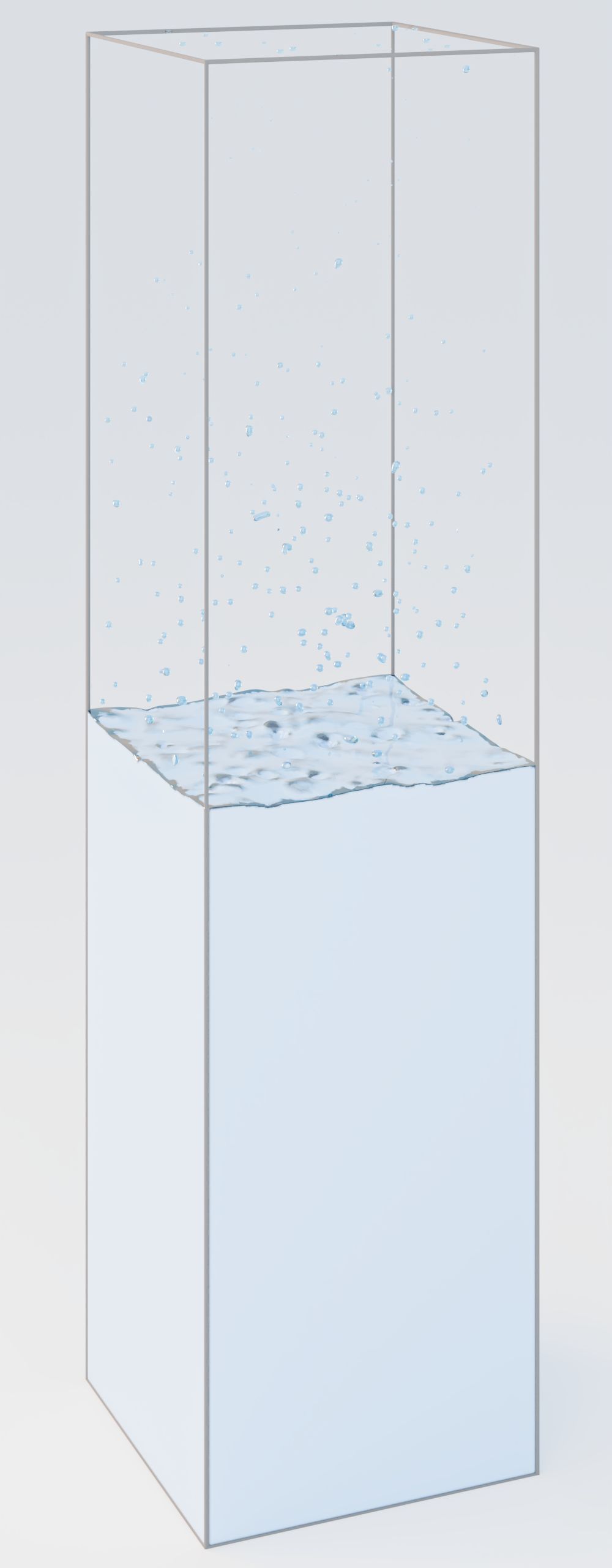
3D Rayleigh-Taylor instability, panel 1 of 8 3D Rayleigh-Taylor instability, panel 2 of 8 3D Rayleigh-Taylor instability, panel 3 of 8 3D Rayleigh-Taylor instability, panel 4 of 8 3D Rayleigh-Taylor instability, panel 5 of 8 3D Rayleigh-Taylor instability, panel 6 of 8 3D Rayleigh-Taylor instability, panel 7 of 8 3D Rayleigh-Taylor instability, panel 8 of 8

Buoyancy-driven mixing

3D Rayleigh-Taylor instability

A denser fluid initially lies above a lighter fluid. A descending spike and interfacial shear vortices develop as the instability grows. The denser phase sinks while the lighter phase rises, eventually approaching a stably stratified equilibrium.
Surface tension-dominated flow, panel 1 of 7 Surface tension-dominated flow, panel 2 of 7 Surface tension-dominated flow, panel 3 of 7 Surface tension-dominated flow, panel 4 of 7 Surface tension-dominated flow, panel 5 of 7
Surface tension-dominated flow, panel 6 of 7 Surface tension-dominated flow, panel 7 of 7

Capillary contraction and breakup

Surface tension-dominated flow

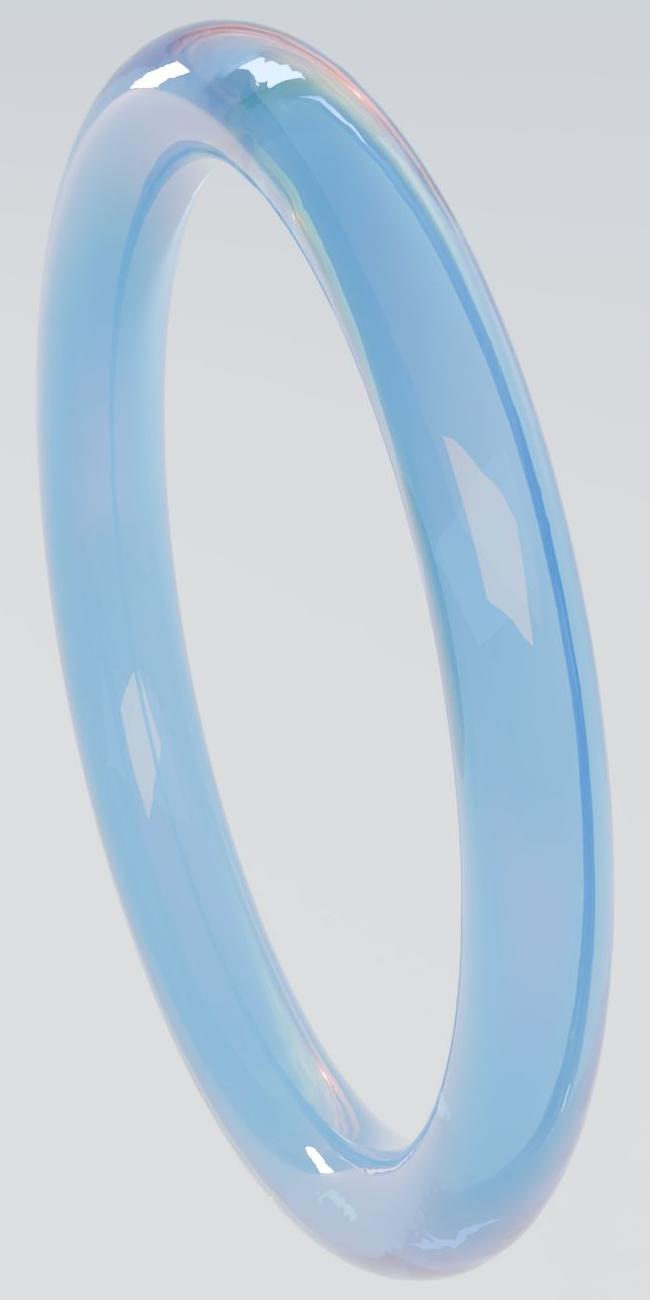
An initially stationary water torus contracts under surface tension in zero gravity, forming a nearly spherical shape before elongating into a liquid rod. The rod subsequently breaks into separate droplets through the Plateau–Rayleigh instability.

Hydrophilic and hydrophobic wetting, panel 1 of 4 Hydrophilic and hydrophobic wetting, panel 2 of 4
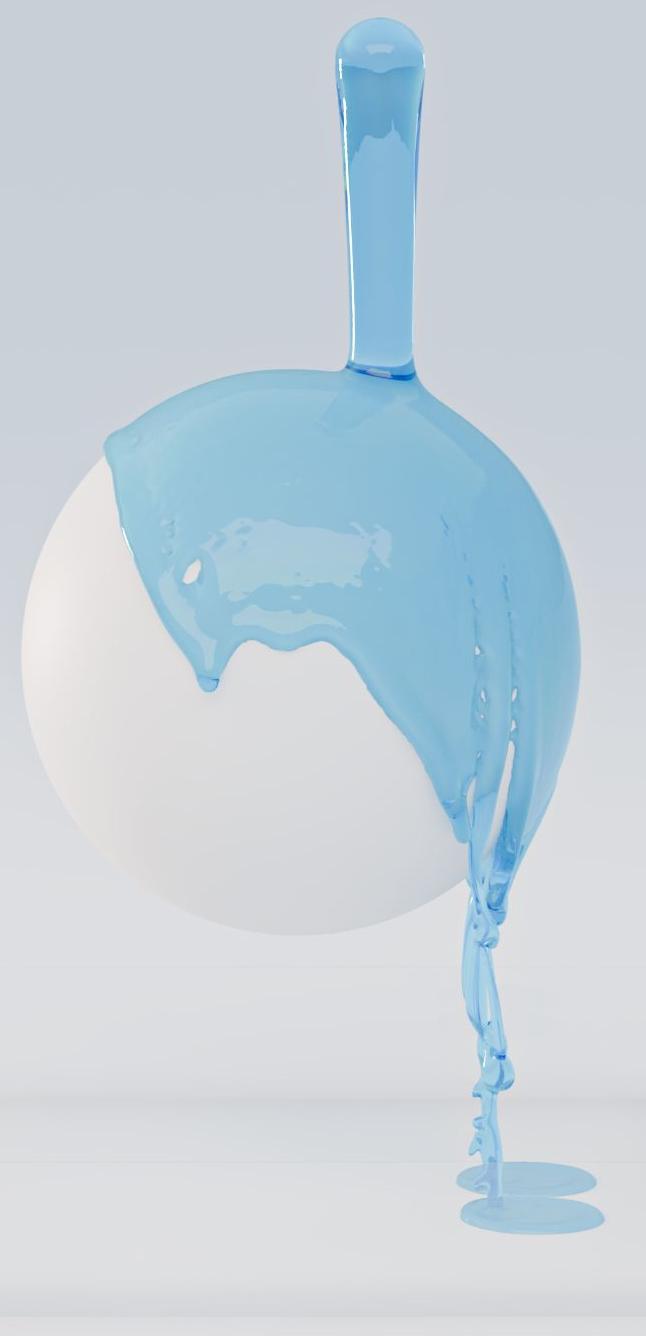
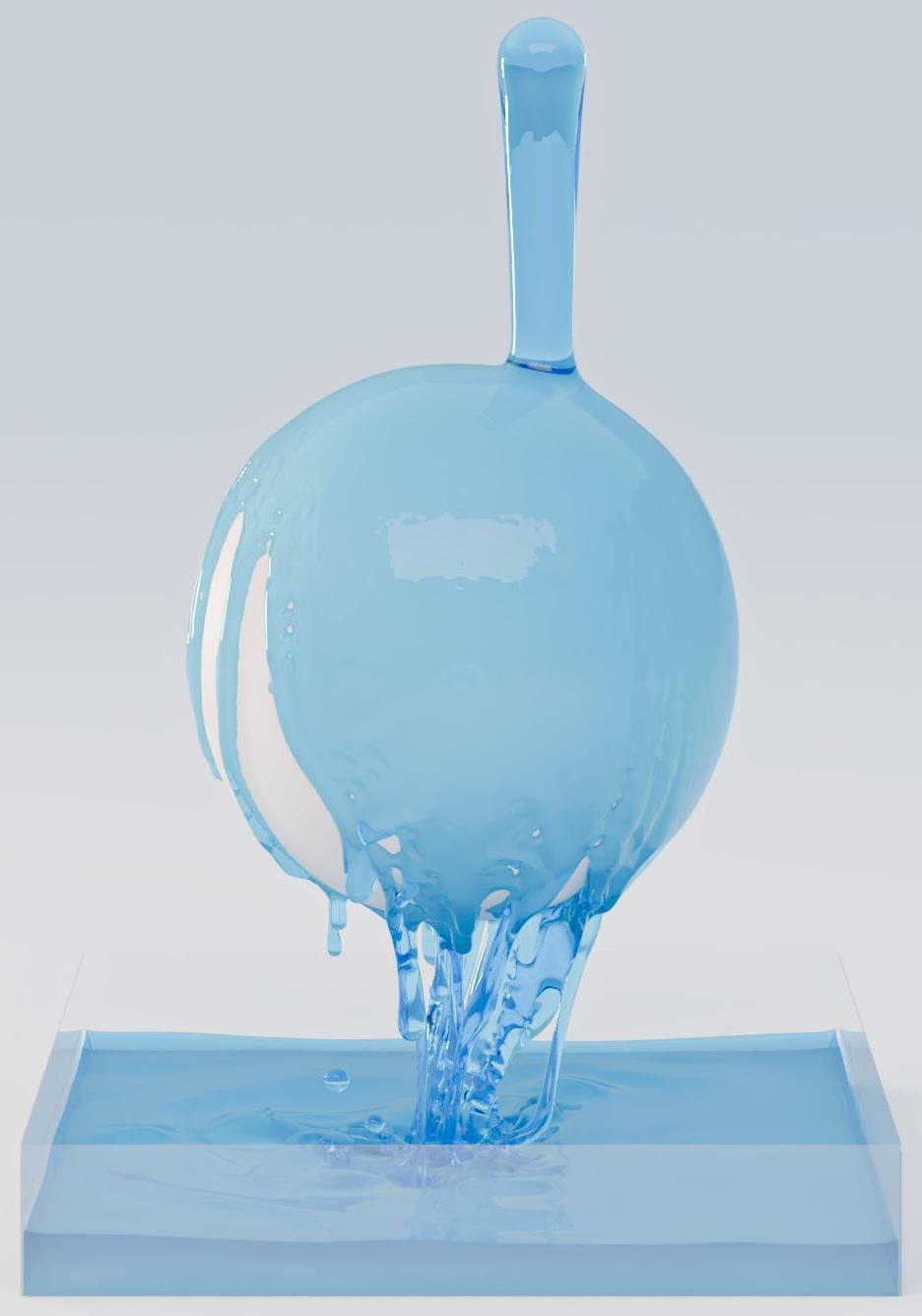
θ = 60° (Hydrophilic)
Hydrophilic and hydrophobic wetting, panel 3 of 4 Hydrophilic and hydrophobic wetting, panel 4 of 4
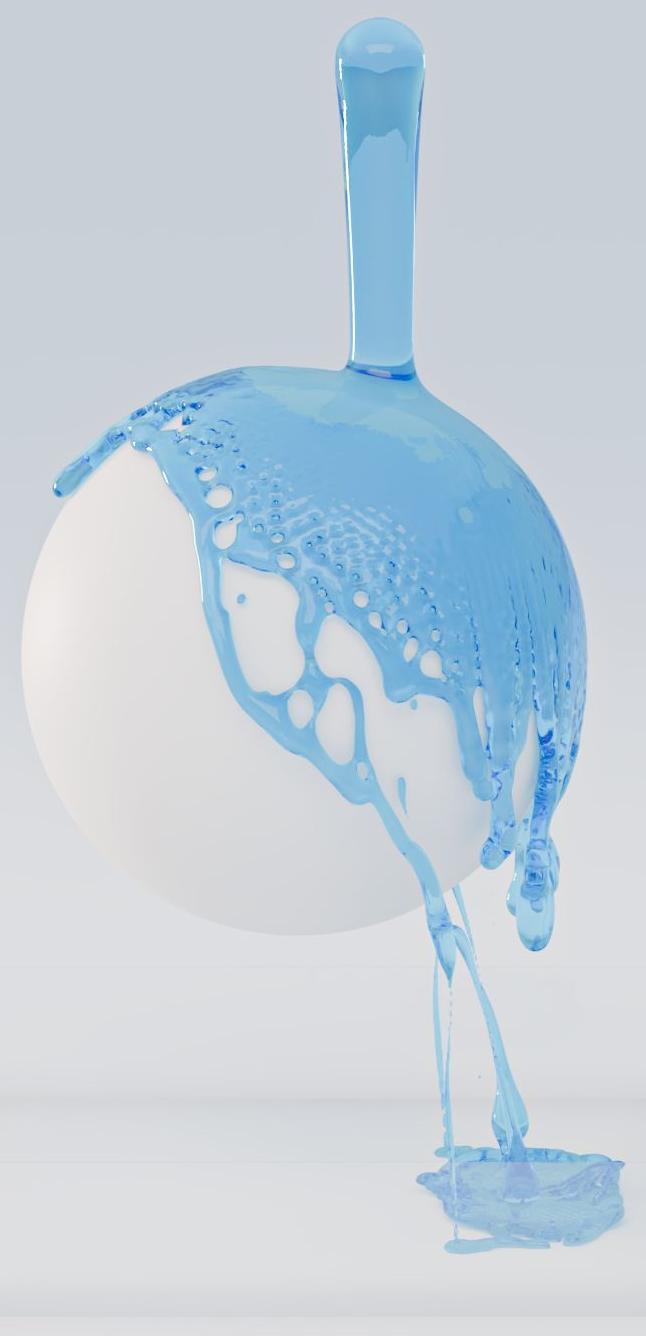
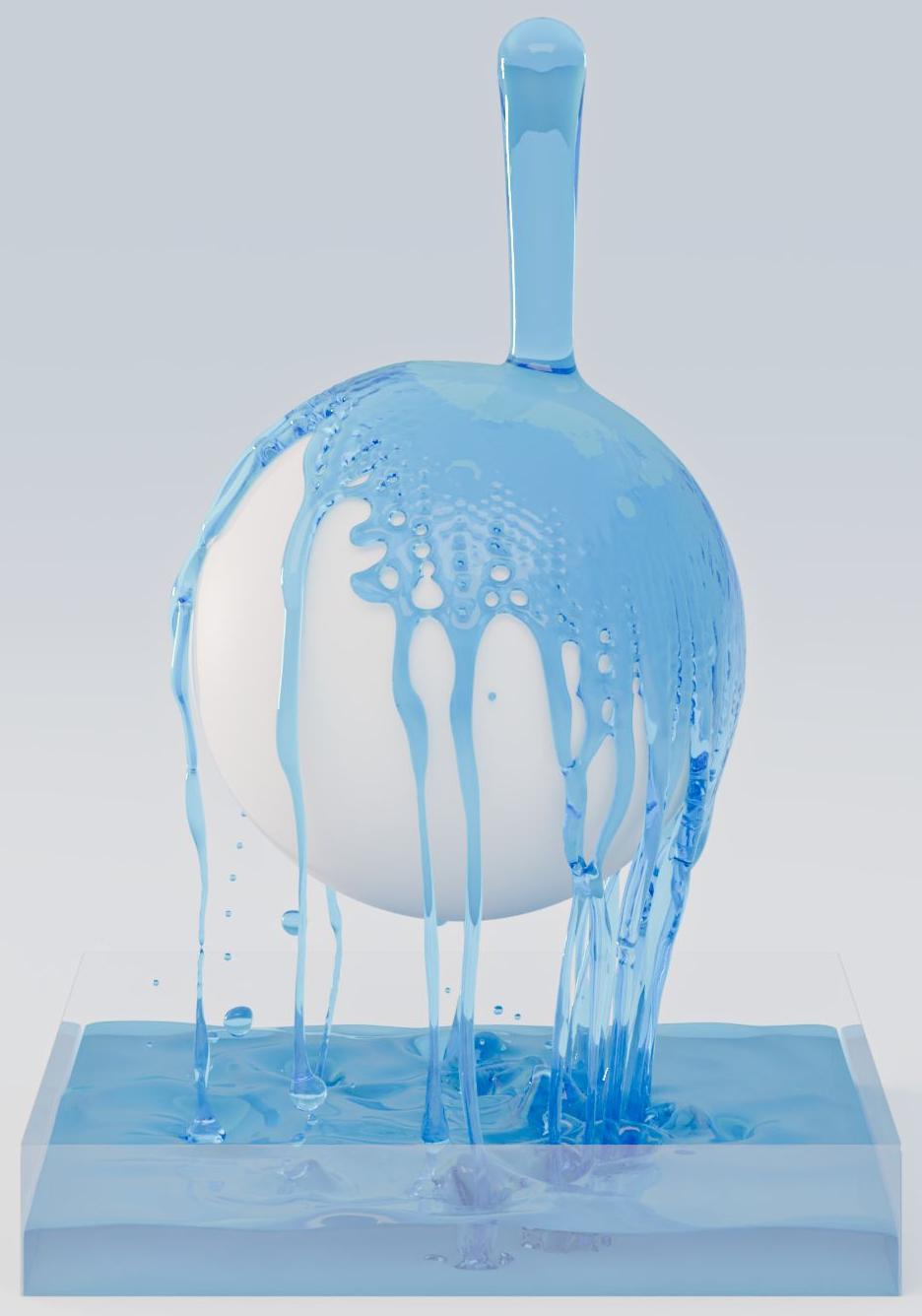
θ = 120° (Hydrophobic)

Surface wettability

Hydrophilic and hydrophobic wetting

Water impinges on hydrophilic and hydrophobic spheres. On the hydrophilic surface, it spreads into a smooth film and detaches farther down. On the hydrophobic surface, weaker adhesion produces a less continuous flow that detaches higher up.

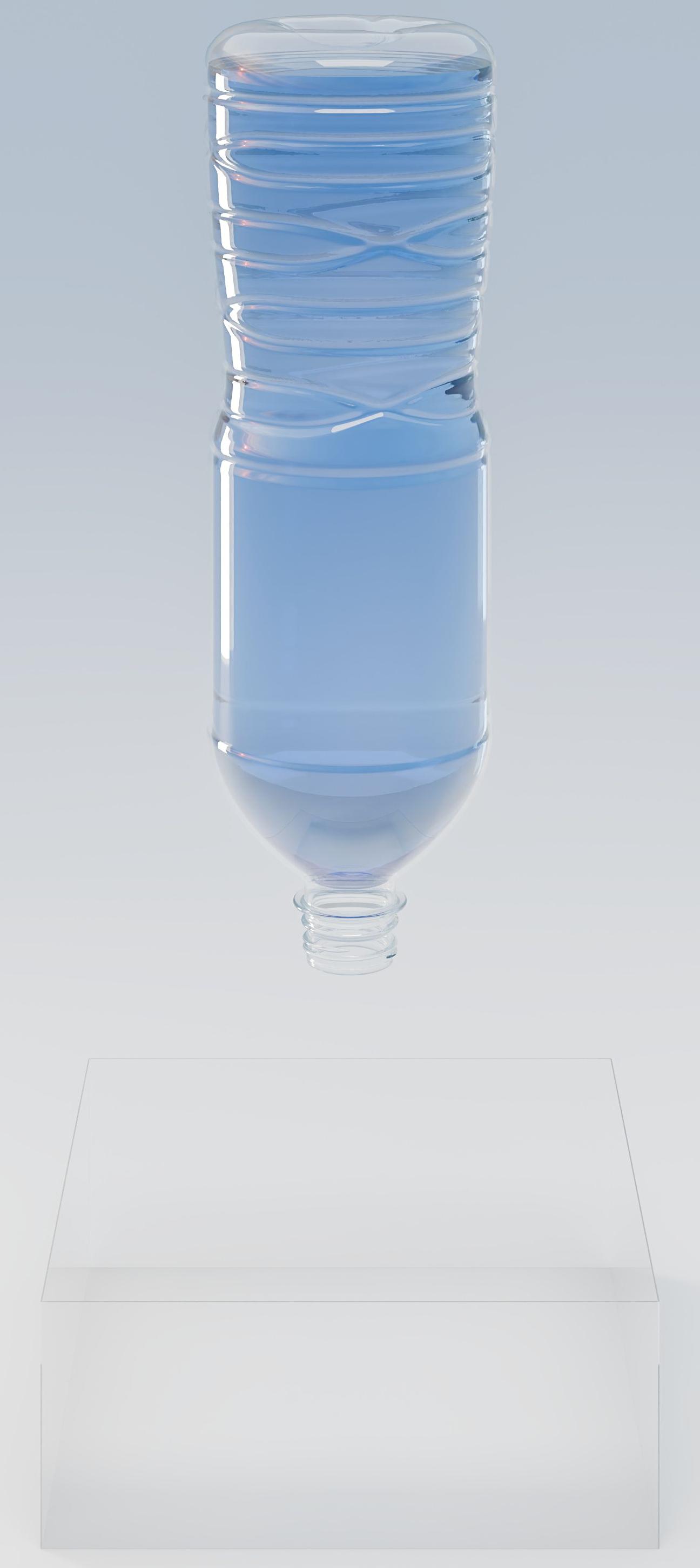
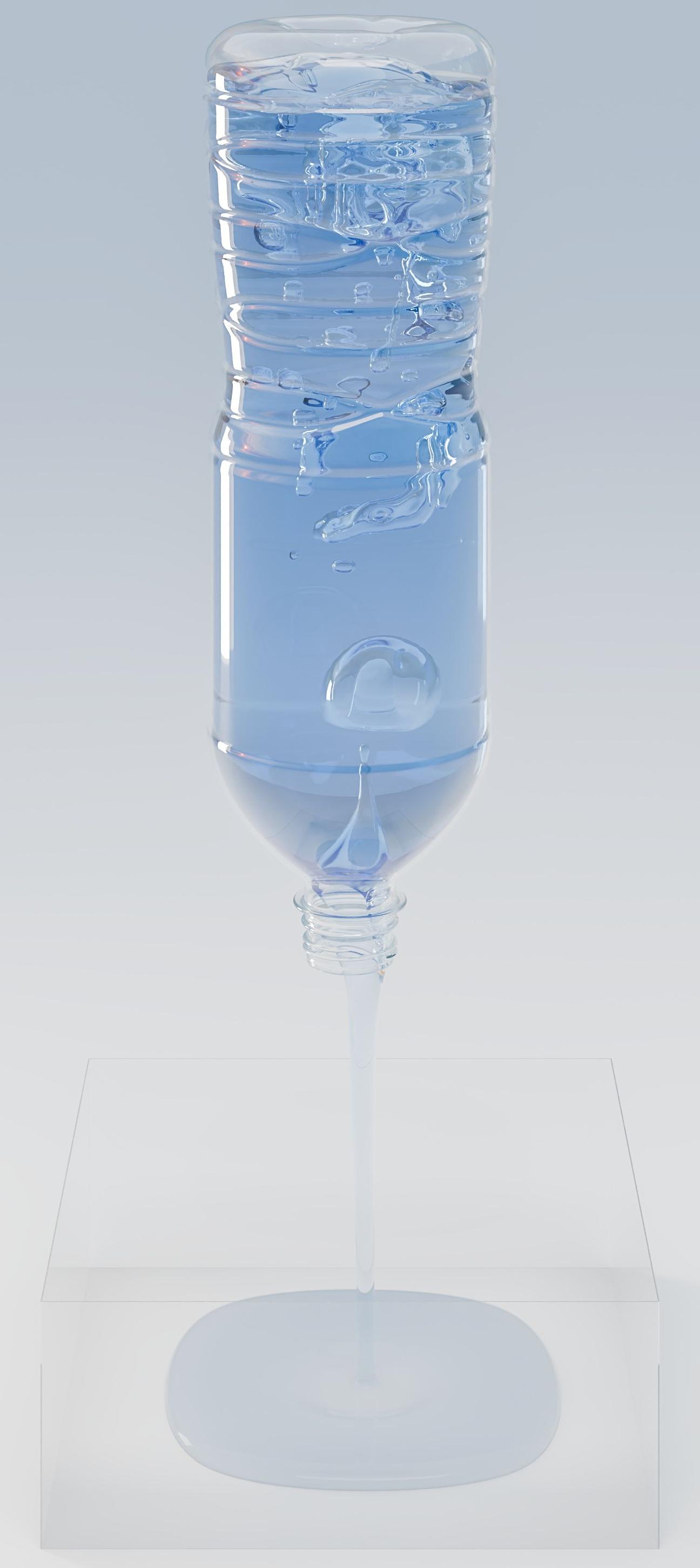
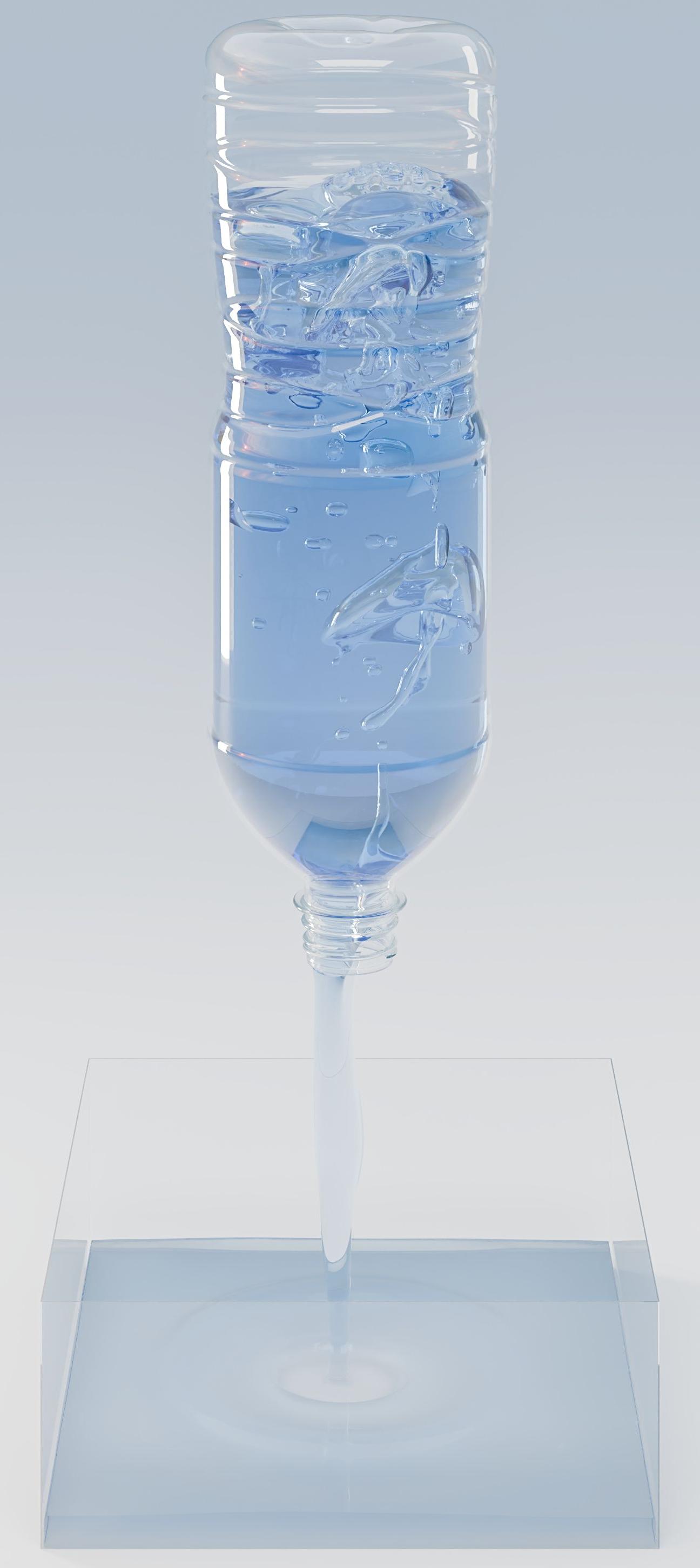
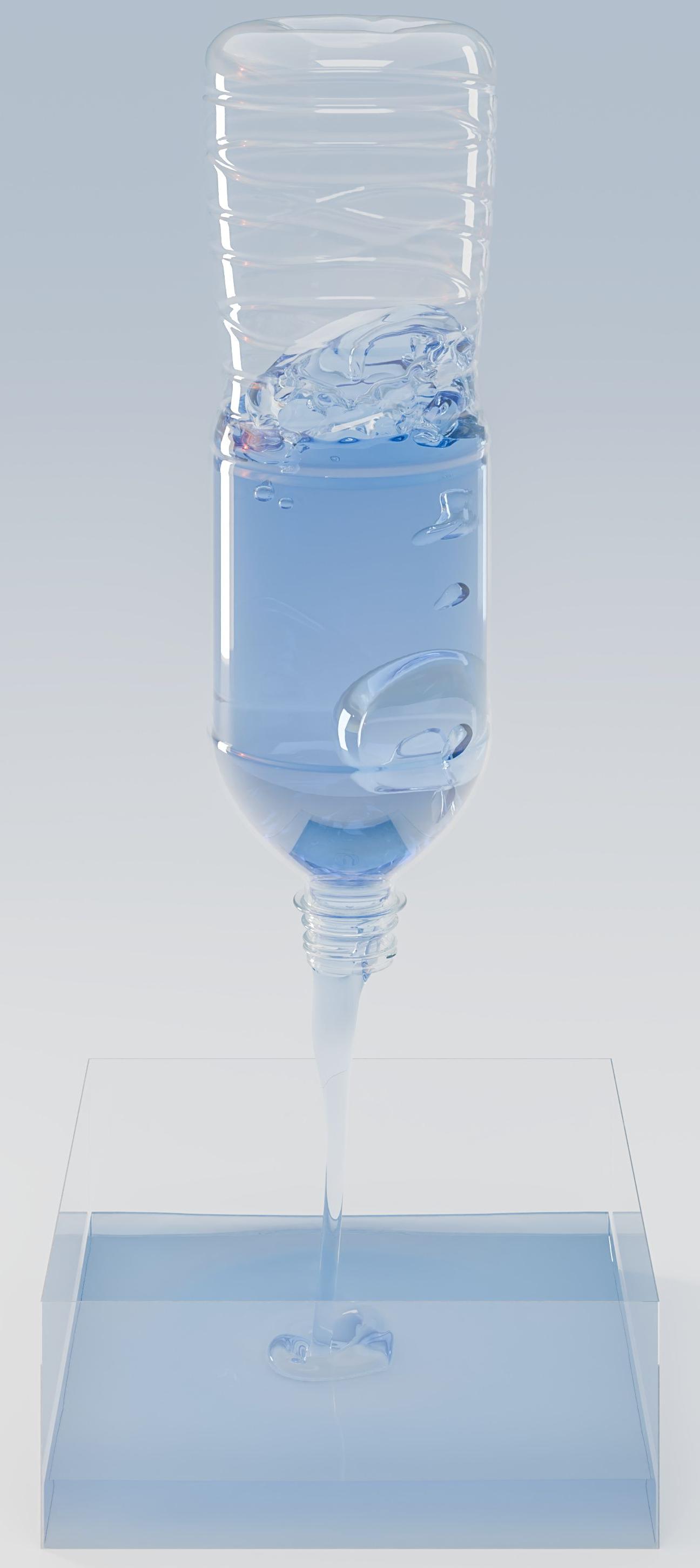
Glugging inside a realistic bottle, panel 1 of 6 Glugging inside a realistic bottle, panel 2 of 6 Glugging inside a realistic bottle, panel 3 of 6 Glugging inside a realistic bottle, panel 4 of 6 Glugging inside a realistic bottle, panel 5 of 6 Glugging inside a realistic bottle, panel 6 of 6

Air-water exchange

Glugging inside a realistic bottle

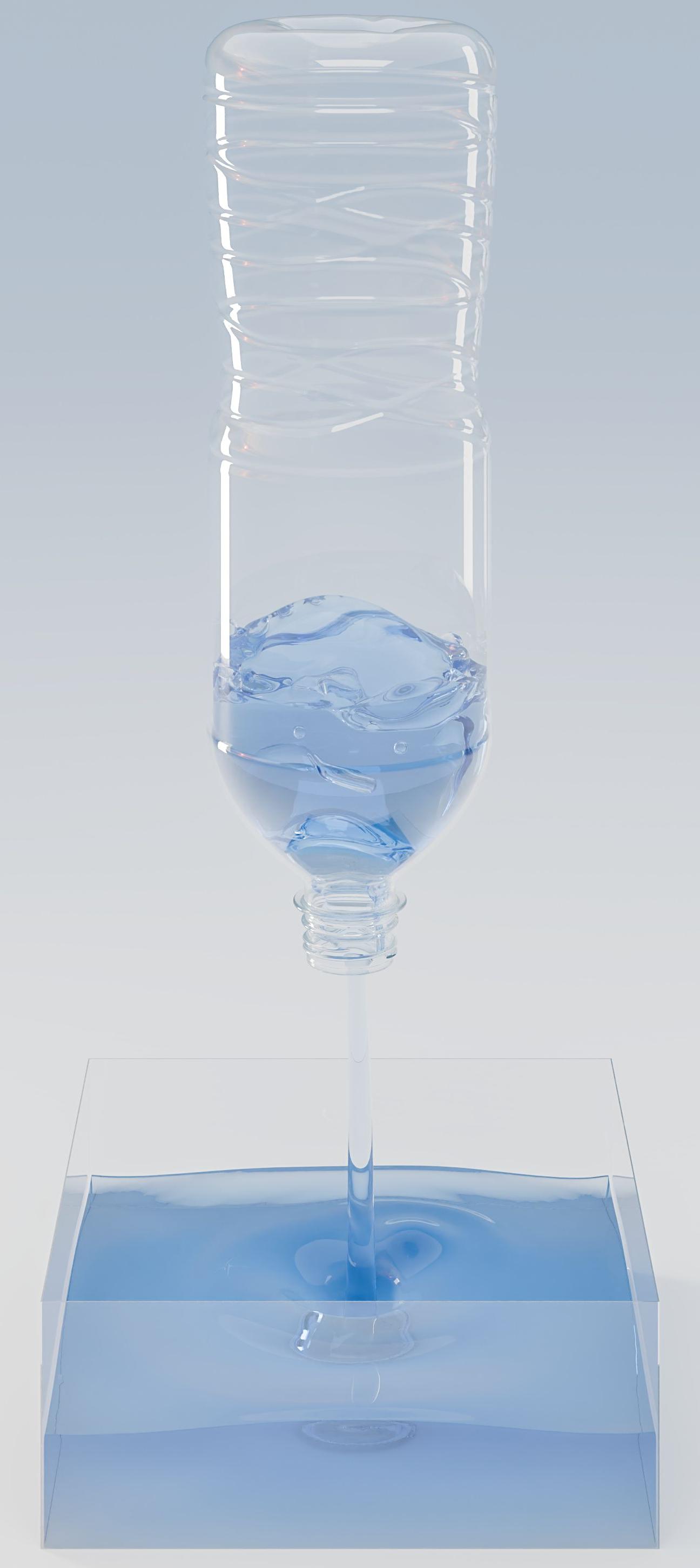
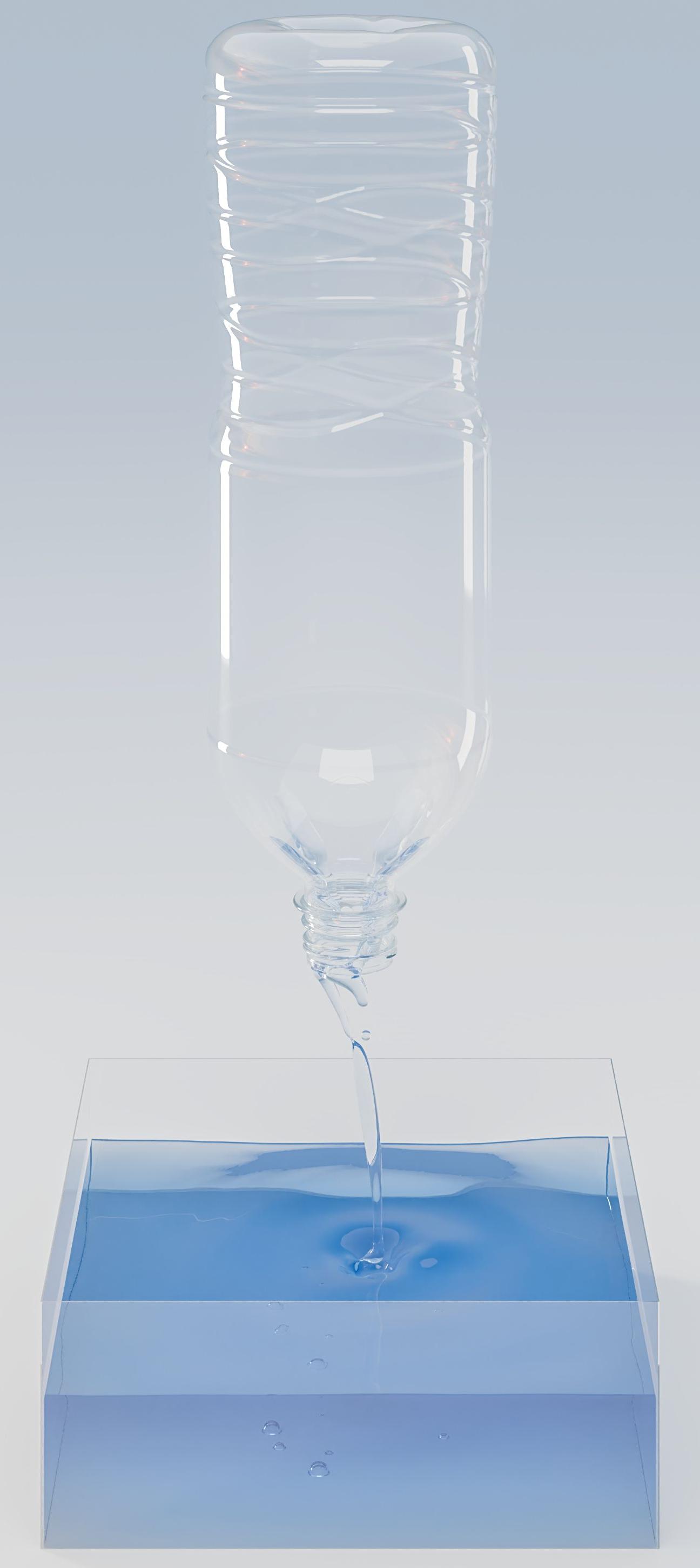
Water drains from an inverted bottle while incoming air rises as bubbles. The small initial air headspace produces rapid pressure fluctuations and frequent glugging. As more air enters, the glugging frequency decreases slightly while the bottle continues to drain.

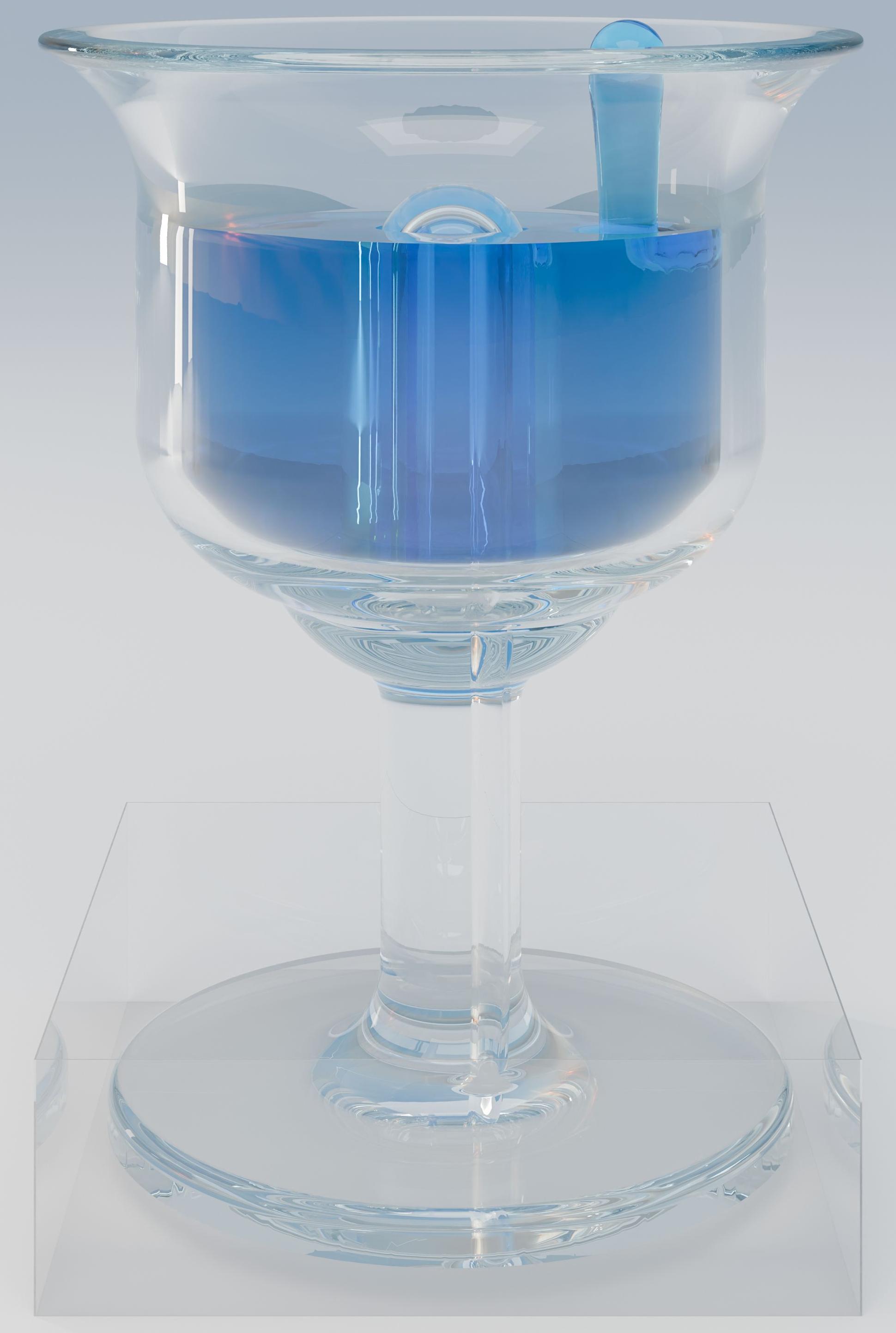
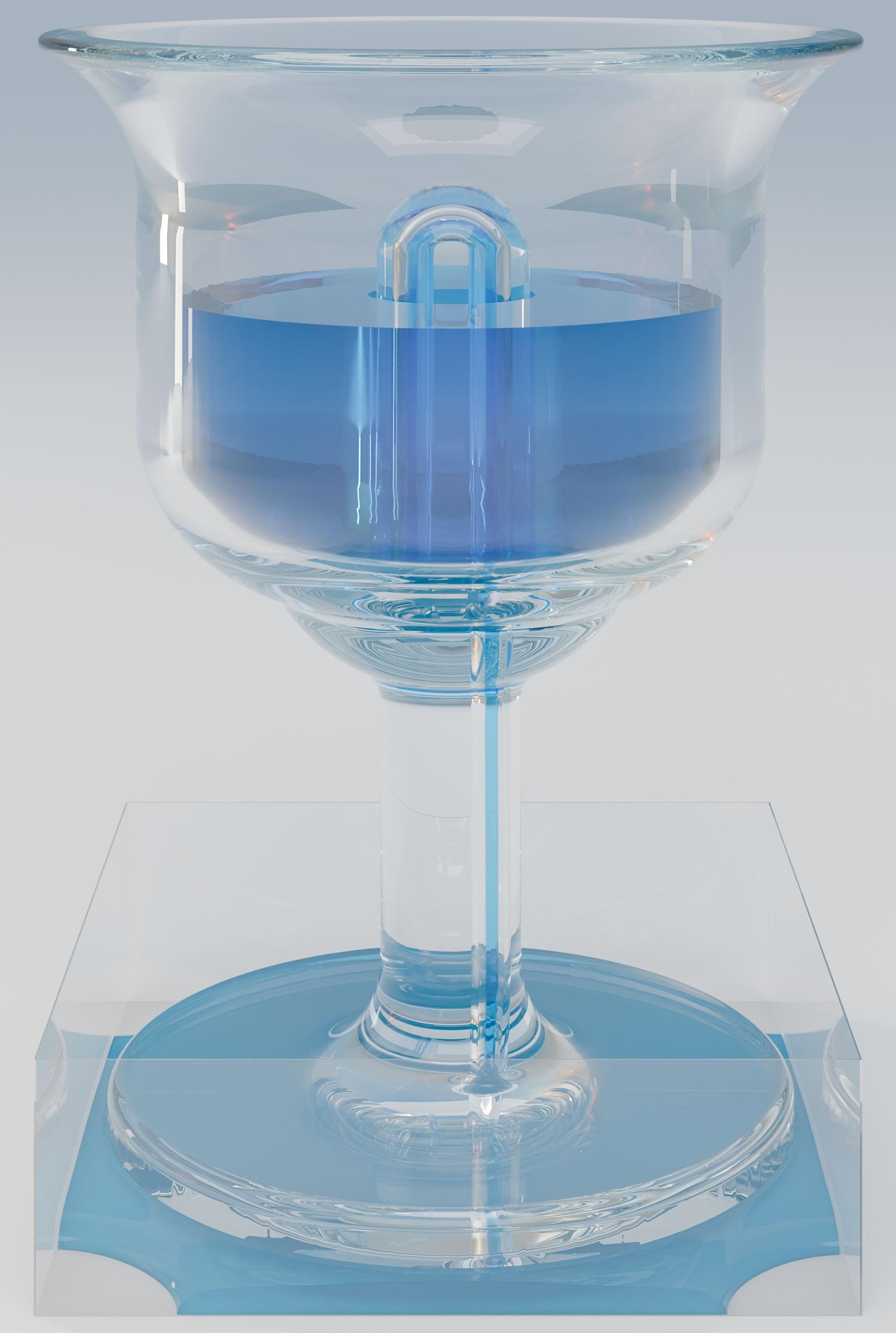
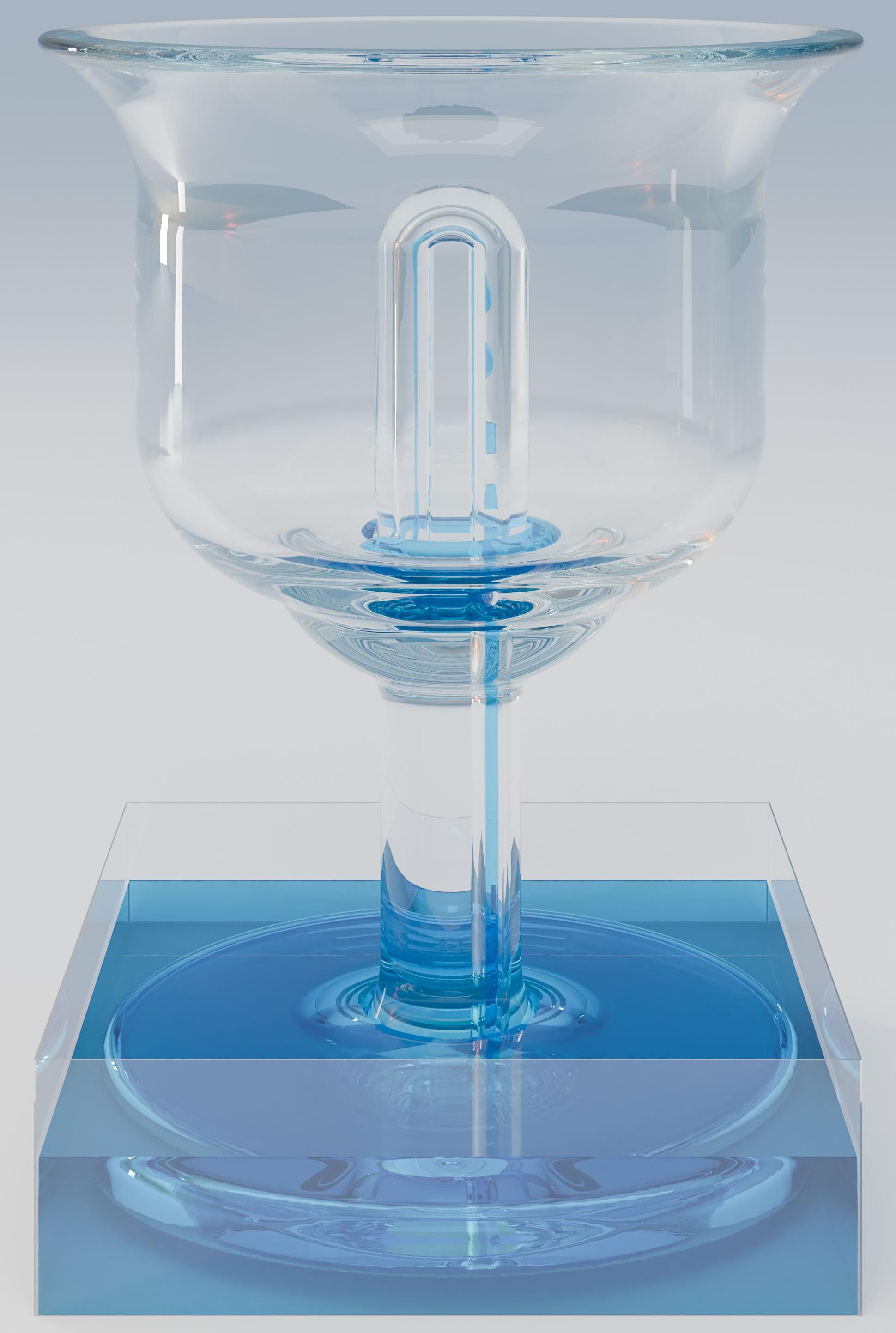
Siphon with a Pythagoras cup, panel 1 of 5 Siphon with a Pythagoras cup, panel 2 of 5 Siphon with a Pythagoras cup, panel 3 of 5 Siphon with a Pythagoras cup, panel 4 of 5 Siphon with a Pythagoras cup, panel 5 of 5

Pressure-driven siphoning

Siphon with a Pythagoras cup

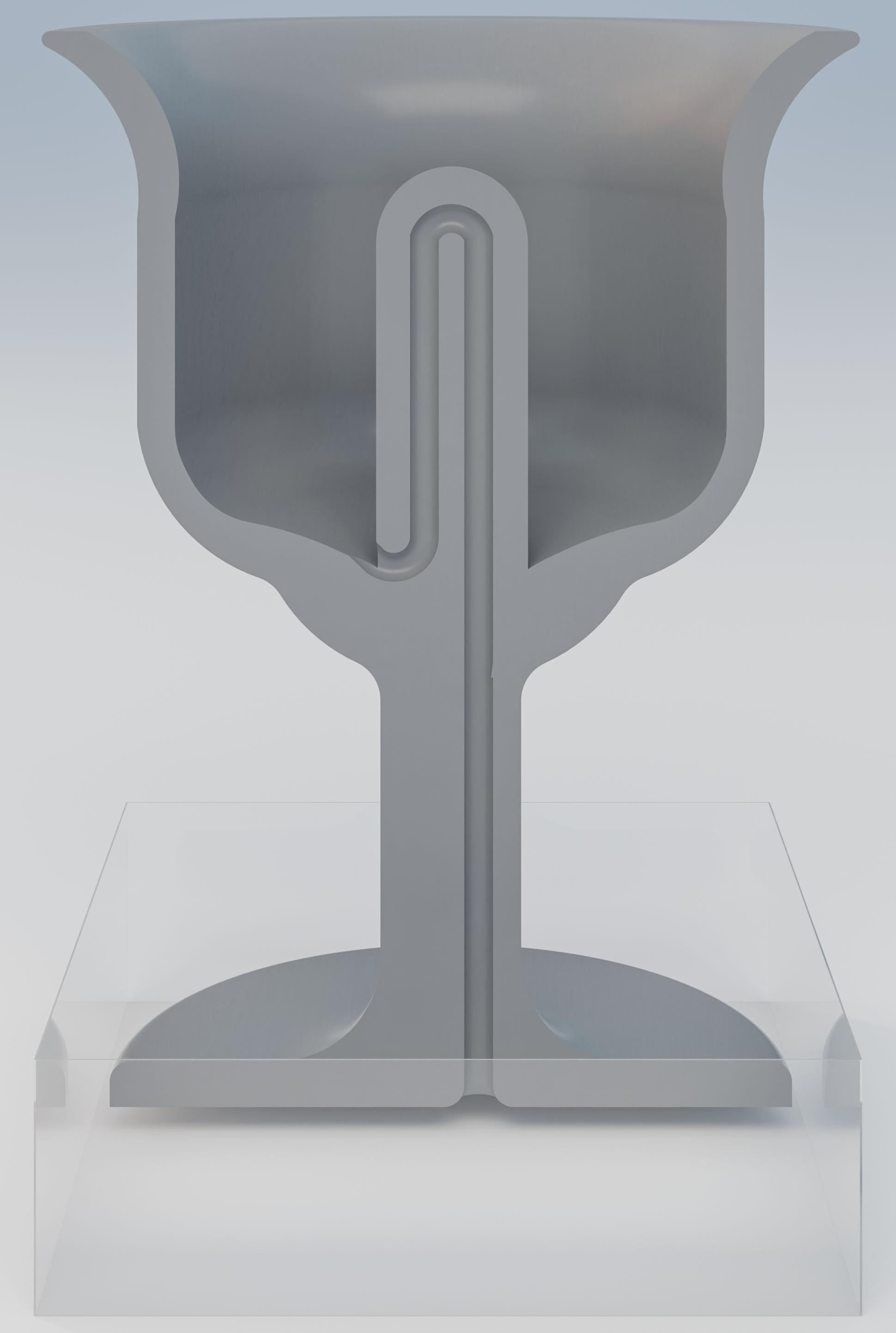
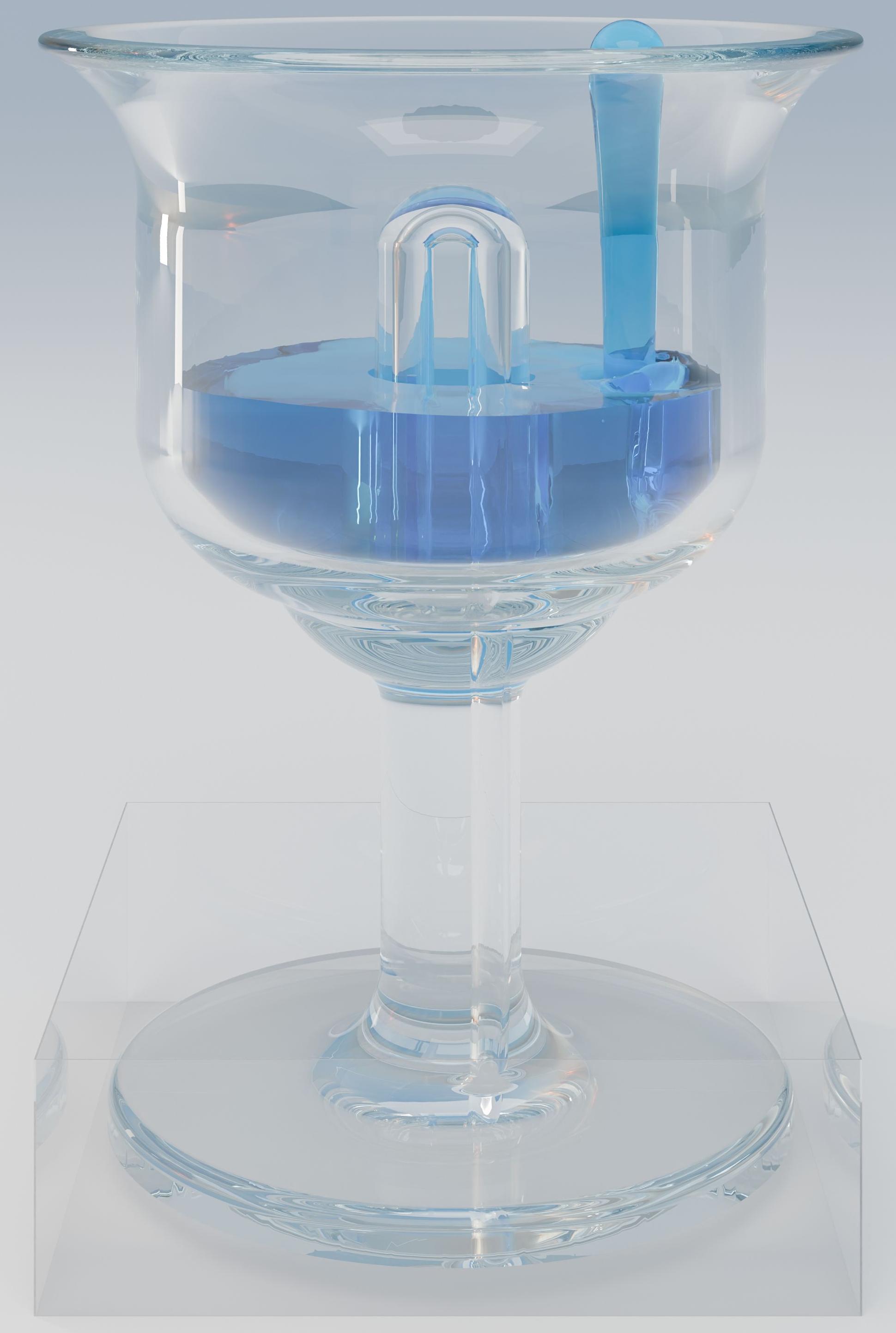
Water gradually fills a Pythagoras cup until its level exceeds the crest of the internal tube, initiating a siphon. After the inlet closes, water continues flowing through the tube into the reservoir below until the cup is nearly empty.

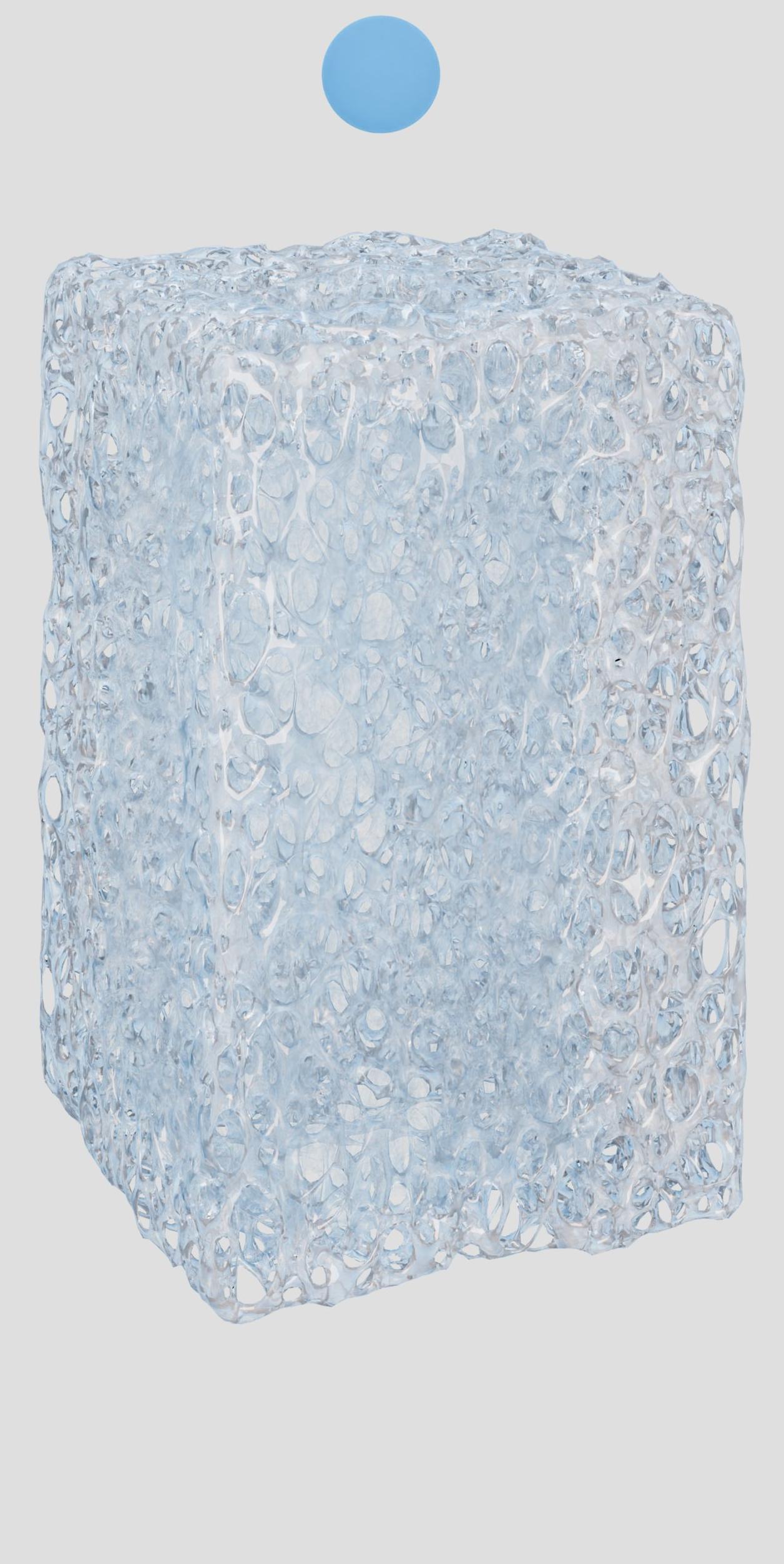
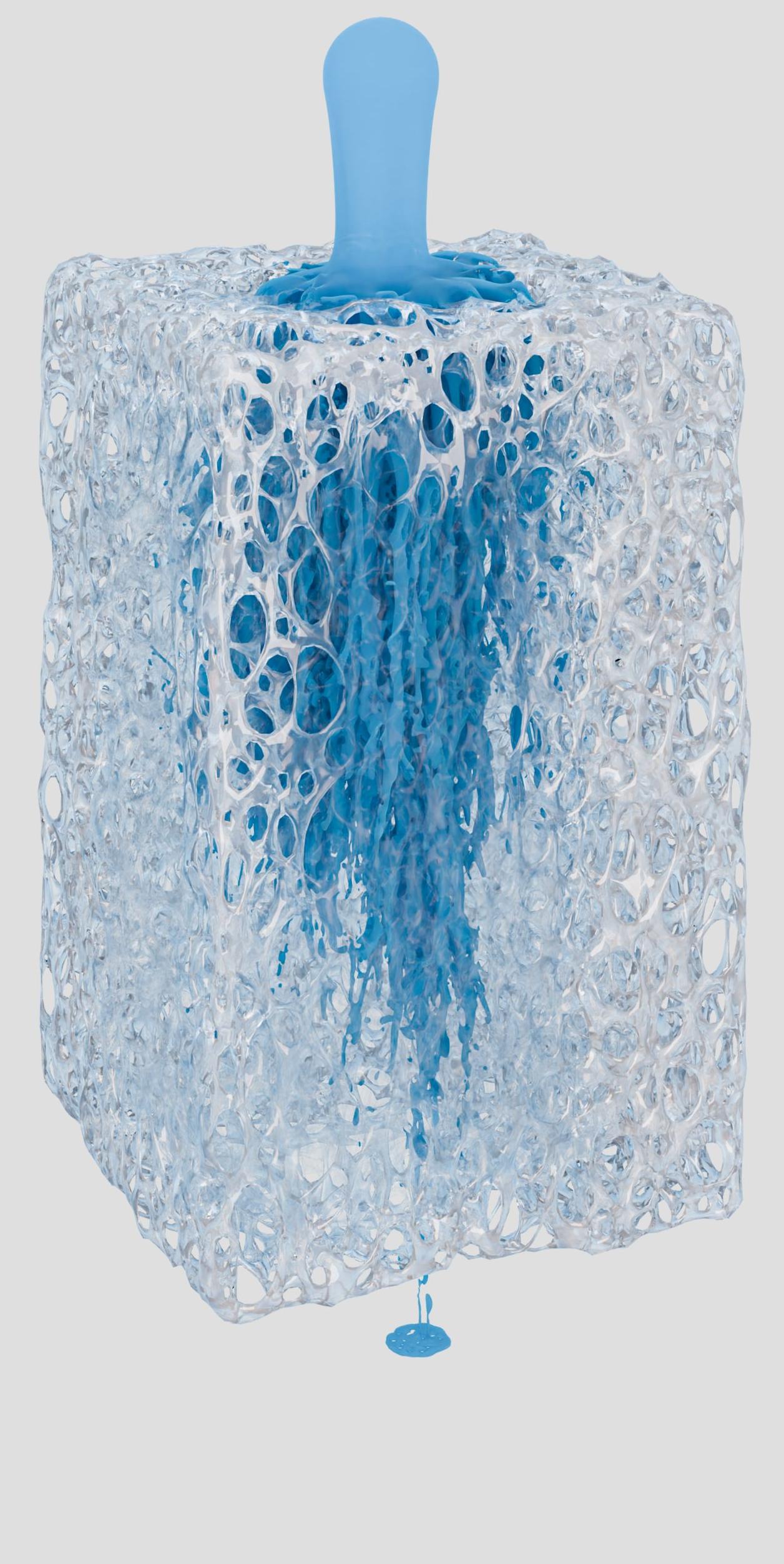
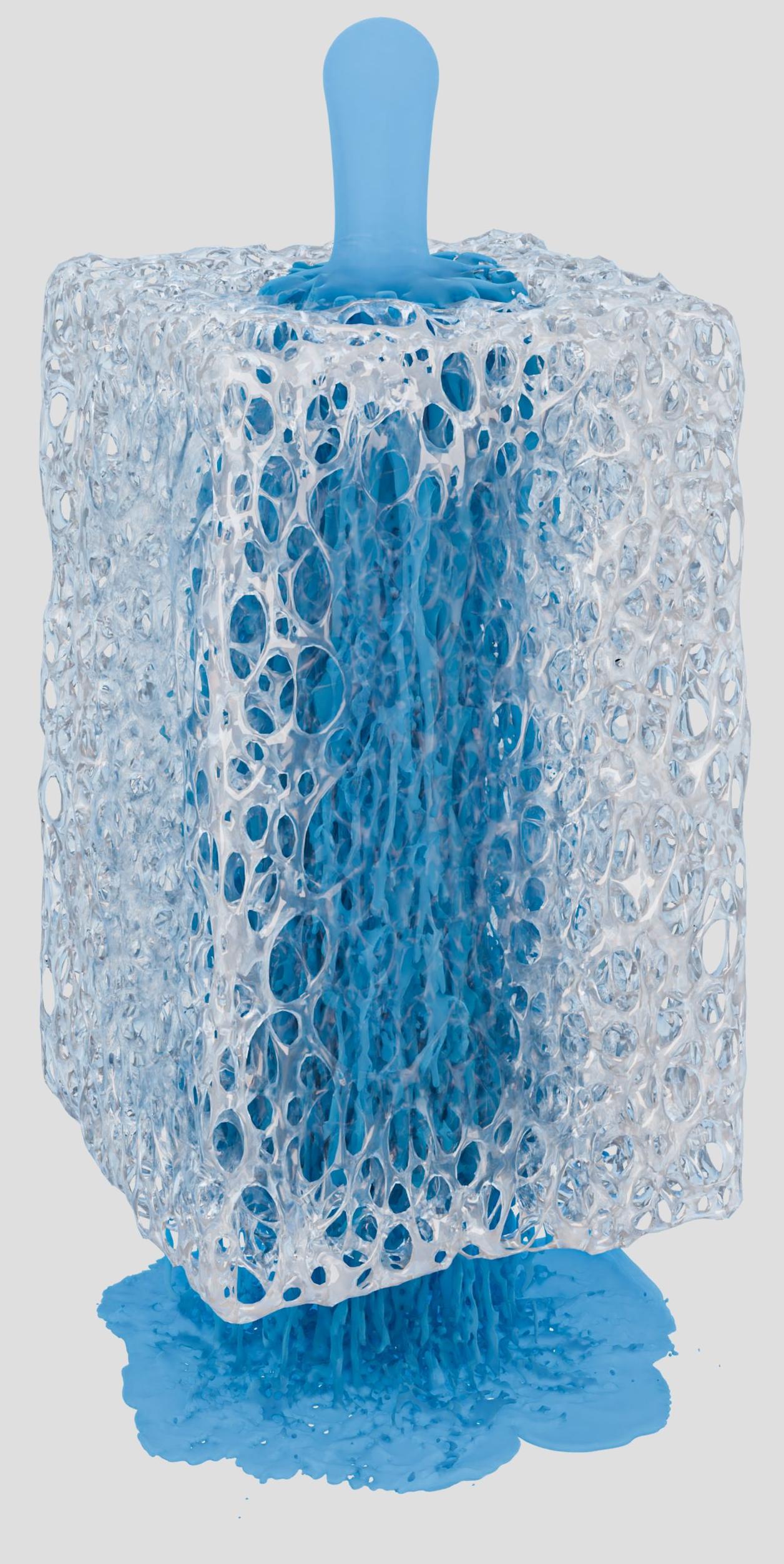
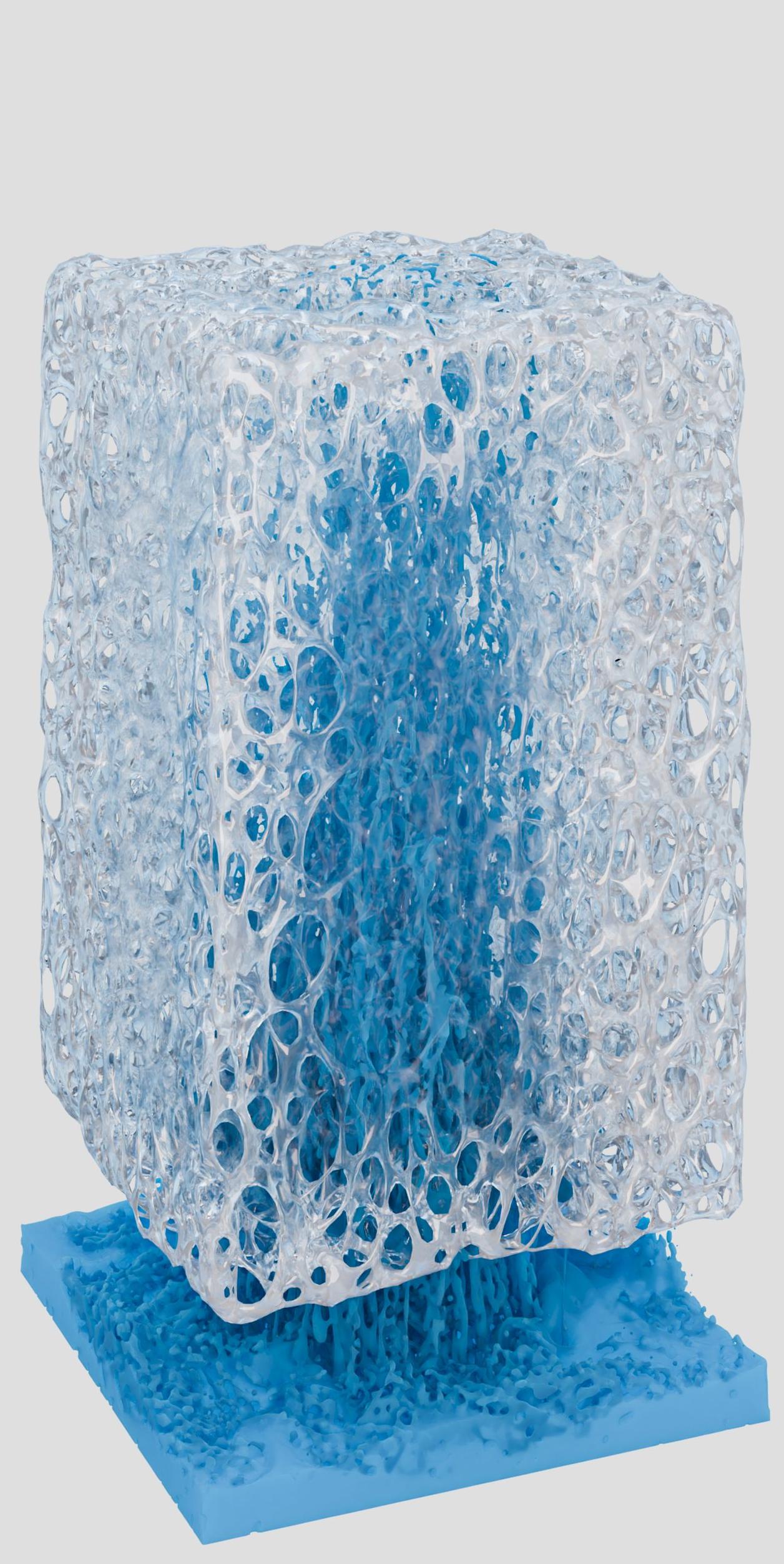
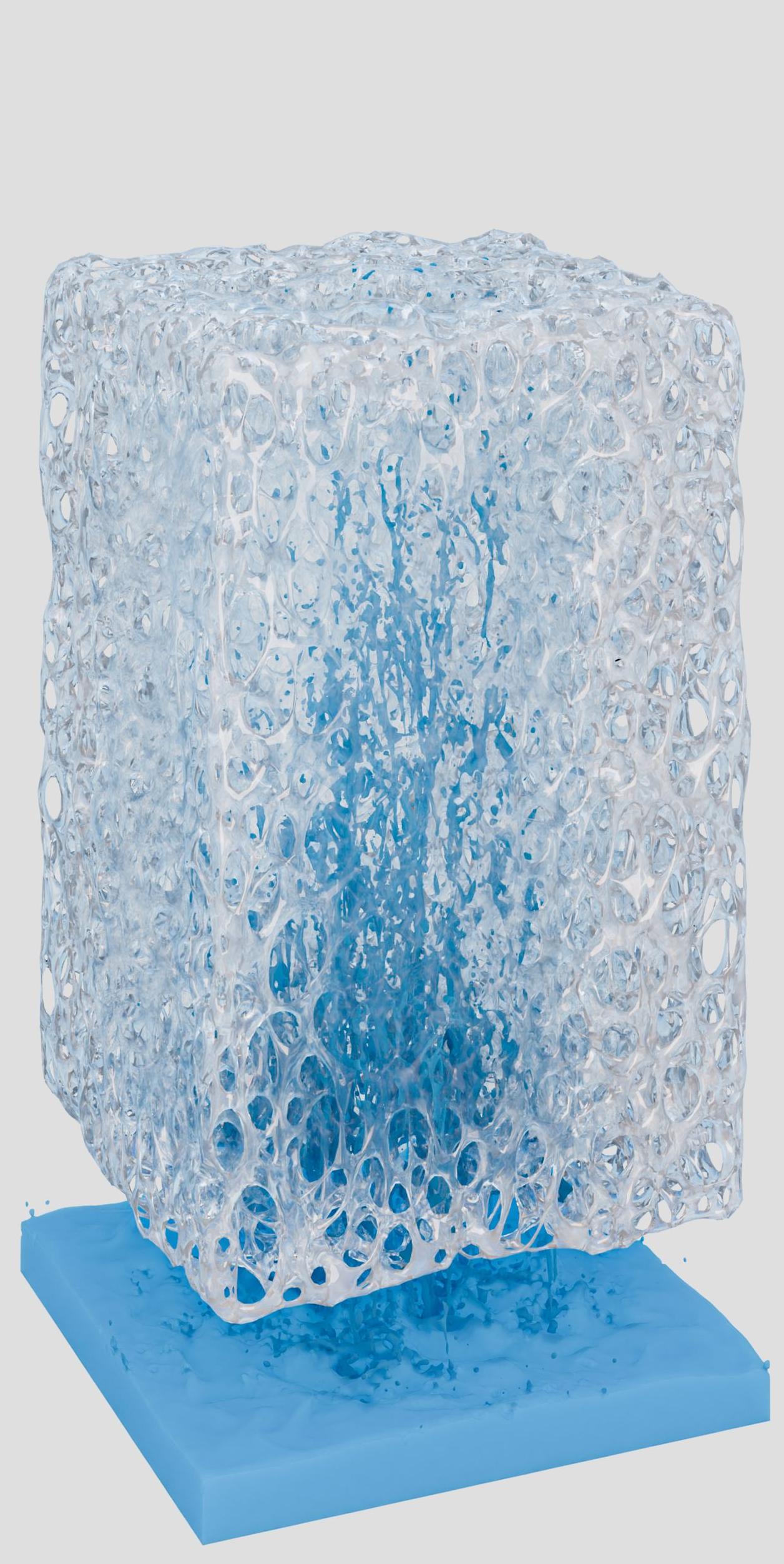
Injection into porous media, panel 1 of 6 Injection into porous media, panel 2 of 6 Injection into porous media, panel 3 of 6 Injection into porous media, panel 4 of 6 Injection into porous media, panel 5 of 6 Injection into porous media, panel 6 of 6

Flow in complex porous media

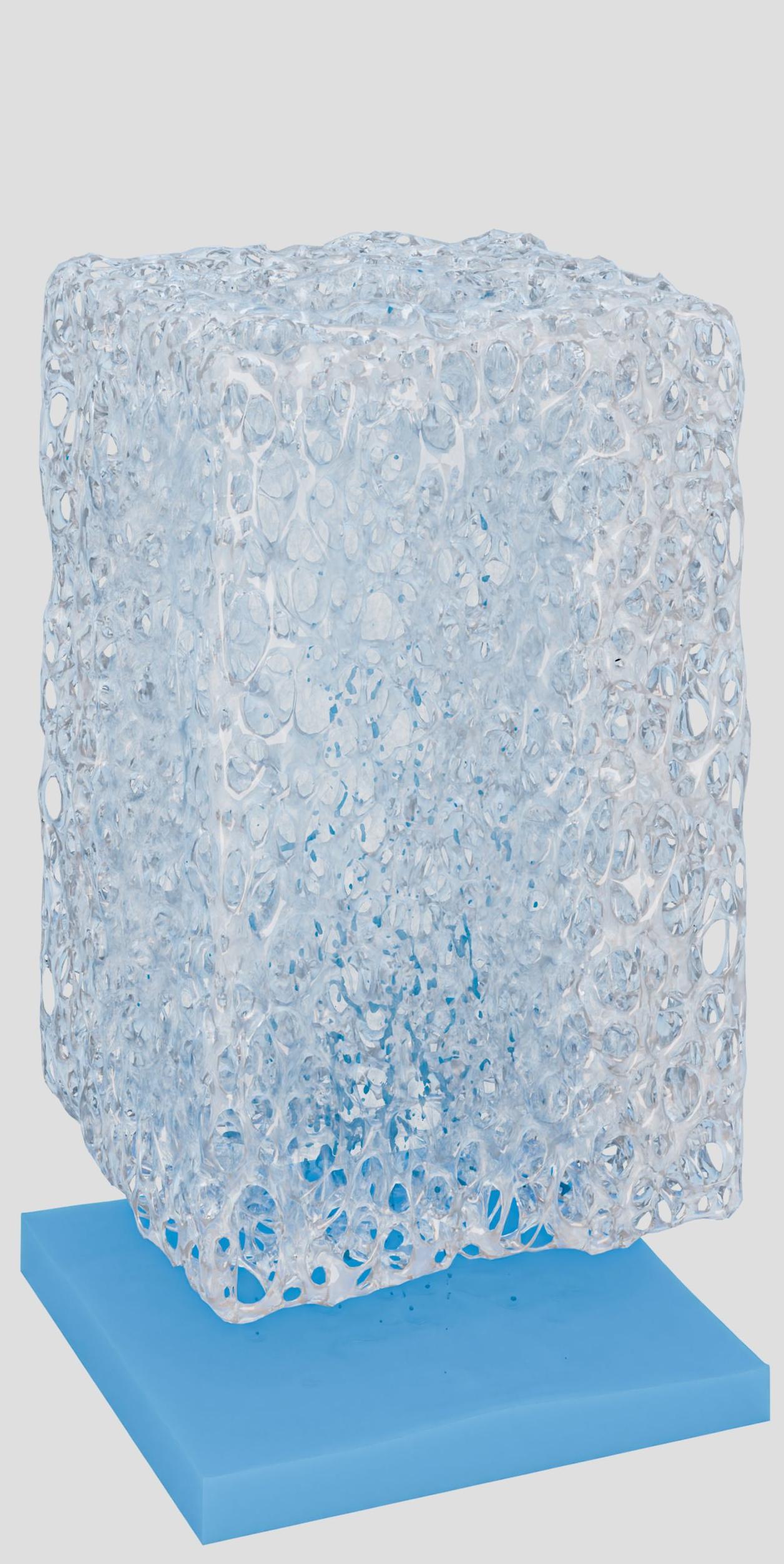
Injection into porous media

Water injected from above follows branching paths through a porous medium under gravity. As it descends, the flow spreads through interconnected pores. After the inlet closes, the remaining water drains through these channels and collects in a puddle below.

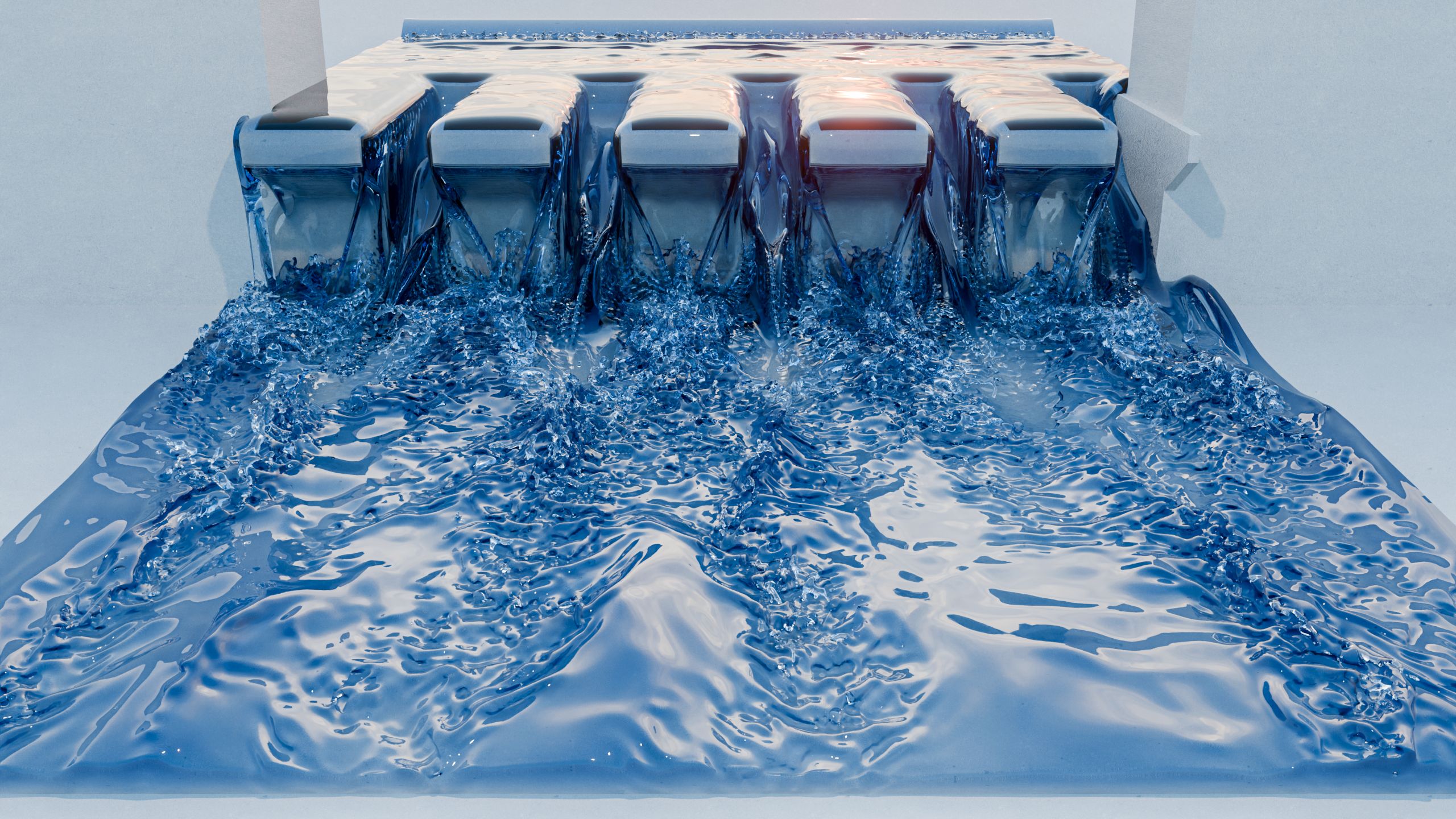
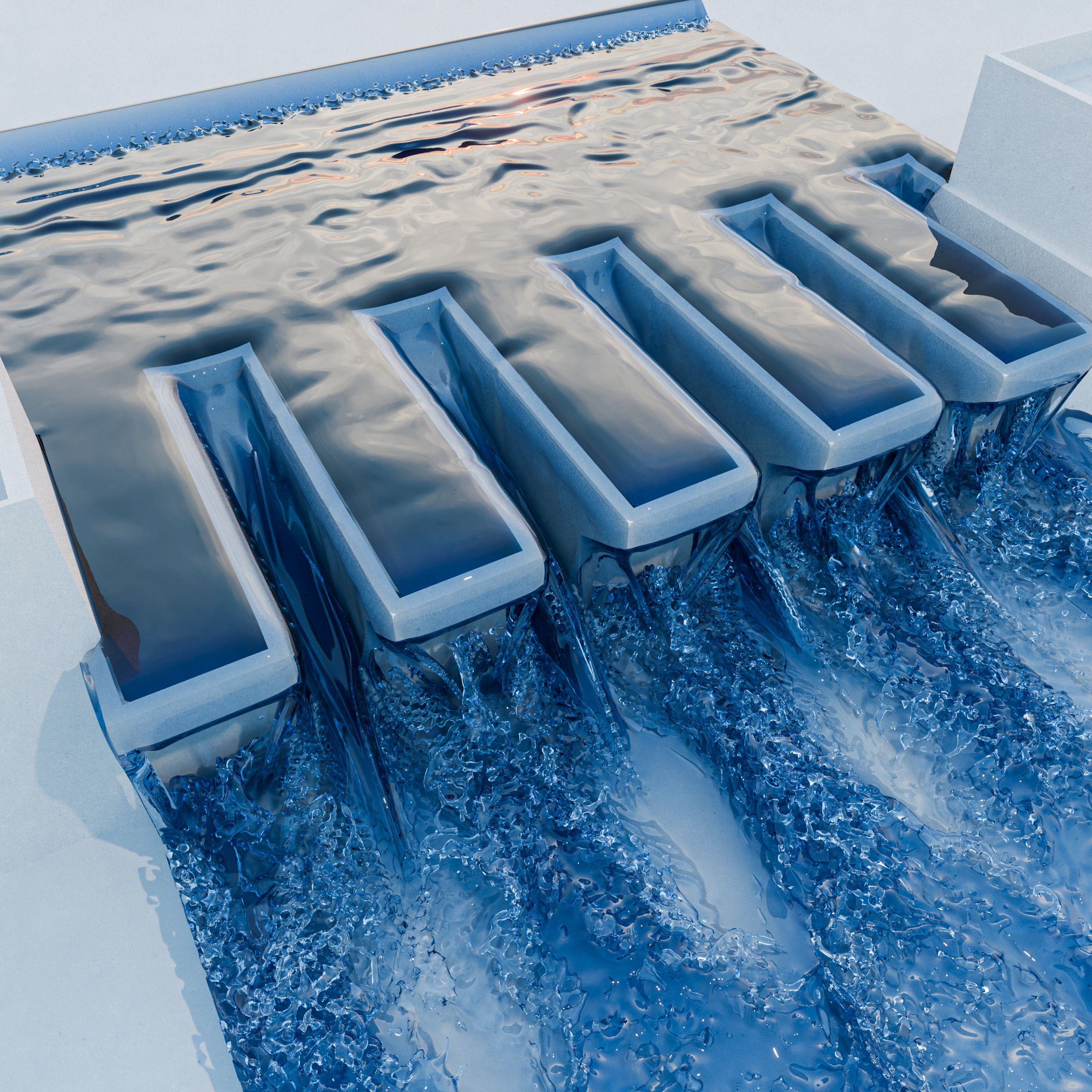
Simulation of the piano key weir, panel 1 of 2 Simulation of the piano key weir, panel 2 of 2

Large-scale hydraulic flow

Simulation of the piano key weir

A continuous inflow maintains the reservoir level upstream of a piano key weir. The upstream water surface remains relatively calm, while water accelerates over the structure. The overflowing streams enter the downstream channel, where they form turbulent flow.

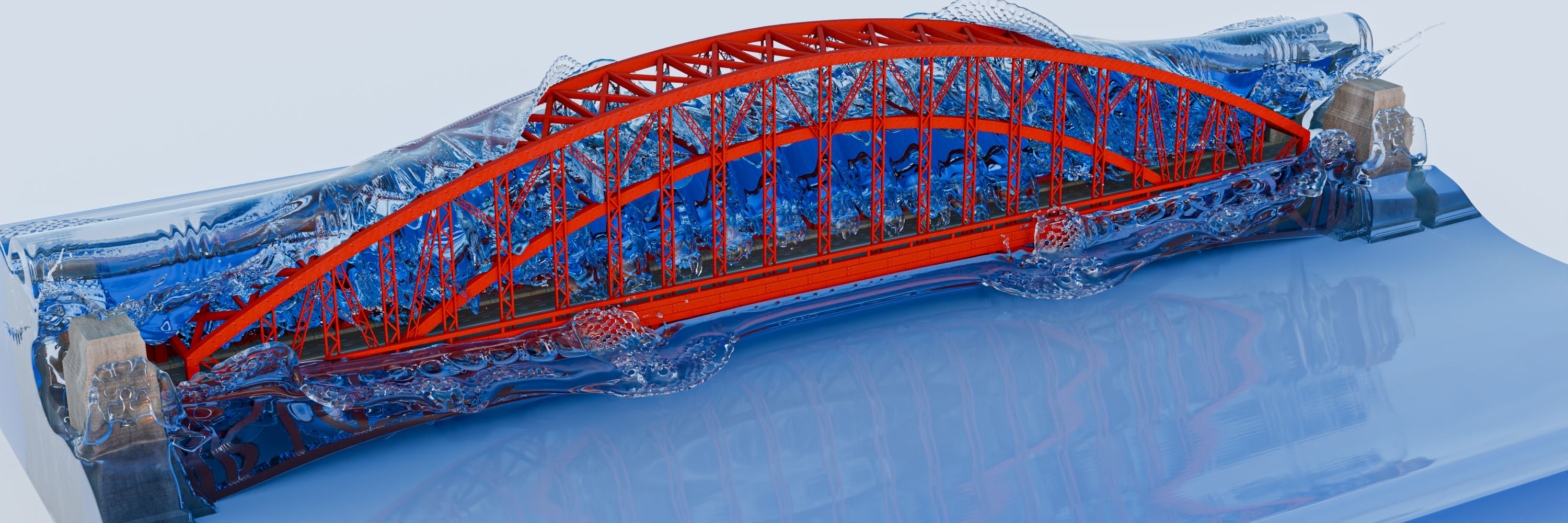
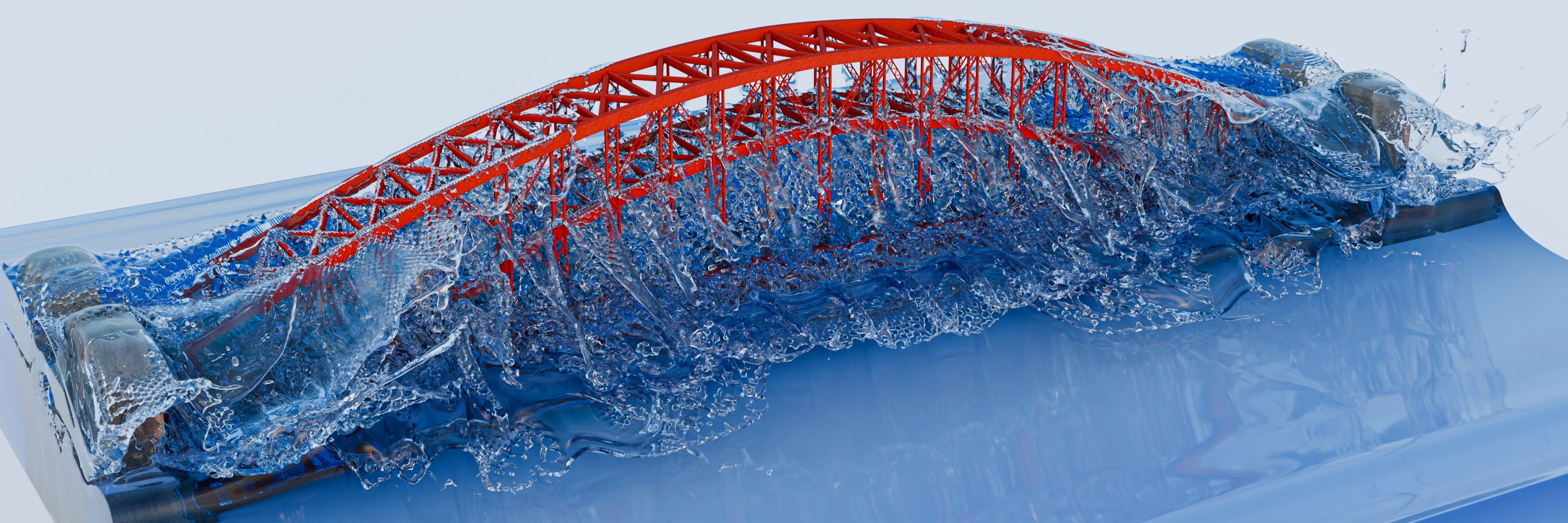
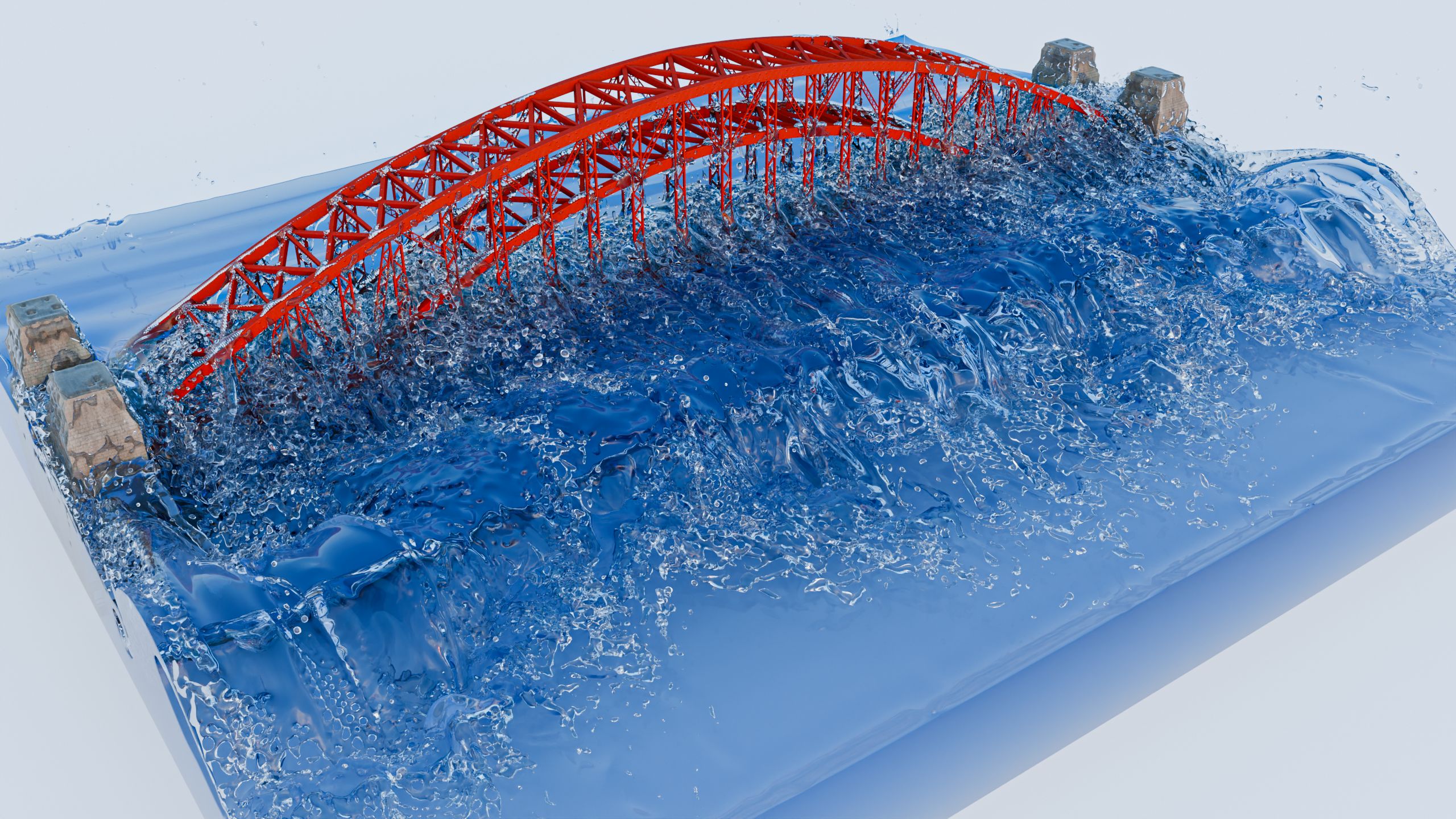
Water wave impact on an arched iron bridge, panel 1 of 3Water wave impact on an arched iron bridge, panel 2 of 3
Water wave impact on an arched iron bridge, panel 3 of 3

Transient wave impact

Water wave impact on an arched iron bridge

A large wave strikes an arched iron bridge and surges through its steel framework. The impact produces fragmented splashes around the structure. Water then propagates downstream as churning waves, leaving a turbulent flow in the wake of the impact.