Lab9: Multi-Issue Processors
Computer Architecture I@ShanghaiTech
Getting Started
Download the files for Lab9 first.
Compare a single-issue processor with a simple in-order two-issue processor. In this lab, the wider machine may issue up to two adjacent instructions per cycle, in program order.
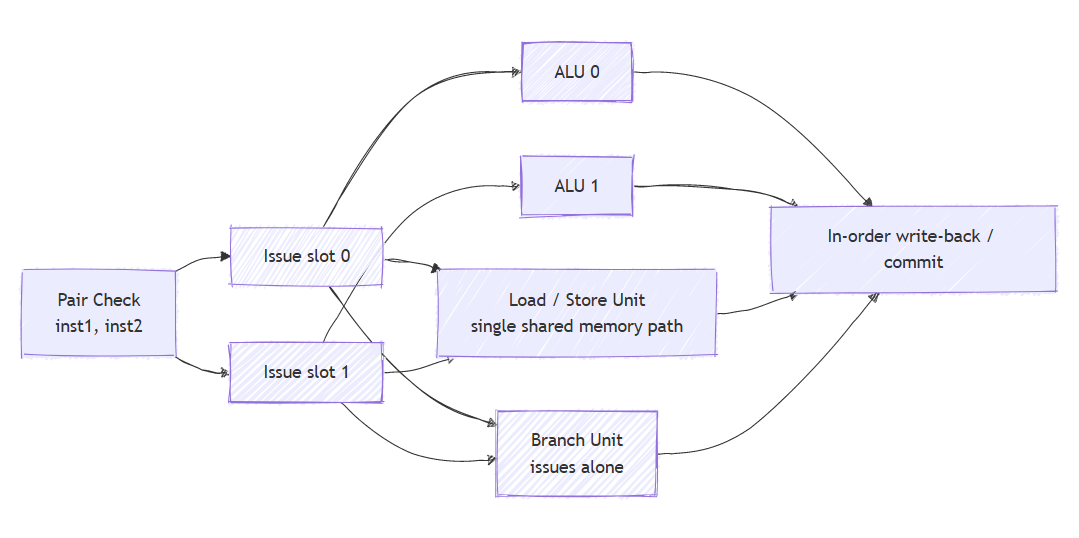
Datapath Model
Use the following simplified in-order two-issue model. The
pairing logic checks only inst1 and the adjacent
inst2. If the pair is legal, both issue in the same
cycle. Otherwise only inst1 issues. Either issue
slot may hold the one memory operation, but both slots share one
LSU path. Branches issue alone.
Tasks
Inspect examples/pairing_examples.txt, then
complete can_pair(inst1, inst2) in
code/can_pair.c using only the pairing rules below.
Do not search ahead or reorder instructions.
For simplicity this lab features multi-issue blocking (no pipelining) model, so you don't have to consider the forwarding mechanisms shown in our lecture slides.
Besides the obvious data hazards, you need to consider the following rules due to the machine model constraint:
- A pair of instructions cannot issue together if either instruction is a branch (branch prediction not considered)
- or both are memory operations (there is only one memory slot and LSU path).
Check
Build and run the checks:
gcc -std=c11 -Wall -Wextra -pedantic \
    code/can_pair.c code/check_can_pair.c \
    -o code/check_can_pair
./code/check_can_pair
The check is expected to fail before you complete the TODOs.
Experiments
Run each trace with issue width 1 and issue width 2:
./sim --width 1 traces/arith.trace
./sim --width 2 traces/arith.trace

./sim --width 1 traces/memory.trace
./sim --width 2 traces/memory.trace

./sim --width 1 traces/mixed.trace
./sim --width 2 traces/mixed.trace
Record the results:
| Trace | Width | Instructions | Cycles | IPC | Unused issue slots | Blocked pairs |
|---|---|---|---|---|---|---|
arith.trace |
1 | |||||
arith.trace |
2 | |||||
memory.trace |
1 | |||||
memory.trace |
2 | |||||
mixed.trace |
1 | |||||
mixed.trace |
2 |
Compute speedup:
speedup = width-1 cycles / width-2 cycles| Trace | Width-1 cycles | Width-2 cycles | Speedup |
|---|---|---|---|
arith.trace |
|||
memory.trace |
|||
mixed.trace |
Questions
Answer briefly, using evidence from your runs.
- Show one pair of instructions from the warm-up examples that can issue together. Why is it allowed?
- Show one pair of instructions blocked by a RAW dependency. Which register causes the dependency?
- Show one pair of instructions blocked by a structural hazard or branch rule. Which rule applies?
- Which trace has the highest IPC with width 2? What pattern helps it?
- Which trace has the lowest speedup? Use blocked pairs or unused slots to explain why.
- Why is the two-issue machine faster than the single-issue machine on some traces?
- Why is the measured speedup less than the ideal 2x?
- If the issue width increased again, would every trace keep speeding up? Explain using your results.